FF&E vs OS&E: What Hotel Owners Actually Pay For
The full split between FF&E (Furniture, Fixtures & Equipment) and OS&E (Operating Supplies & Equipment) for hotel projects — with a sample 4-star budget breakdown and procurement responsibilities.
The FF&E versus OS&E distinction sounds like a definitional curiosity. It isn’t. It determines which budget line each item sits in, who is accountable for procuring it, when in the development calendar it gets ordered, and — most importantly — whether the hotel can actually open with everything it needs to start serving guests.
Owners who blur the boundary end up with one of two failure modes: either FF&E gets over-scoped and operating cash gets diverted to one-time capital purchases, or OS&E gets under-scoped and the hotel opens without enough towels, glassware, or staff uniforms.
The two scopes defined
FF&E (Furniture, Fixtures & Equipment) is the durable physical outfit of the hotel. Loose items, not built-in. Manufactured to specification, typically with lead times of 14–24 weeks. Capitalised on the balance sheet as long-term assets and depreciated over 7–10 years.
OS&E (Operating Supplies & Equipment) is everything else needed to run the hotel as a functioning service business. Consumables, replaceable items, operational equipment. Typically 4–12 week lead times. Often expensed (depending on local accounting rules) and re-procured on a rolling basis throughout the hotel’s operating life.
The line between them is occasionally blurry. Two examples that illustrate:
- A bedside lamp is FF&E. The replacement bulb in the lamp is OS&E.
- A coffee table is FF&E. The decorative coffee-table book on it is OS&E.
The principle: if it’s part of the physical room outfit when the hotel hands over, it’s FF&E. If it’s needed to operate the hotel from day one onwards, it’s OS&E.
What’s in FF&E
Full-scope FF&E for a typical 4-star hotel covers:
| Category | Typical items |
|---|---|
| Guest room | Bed, mattress, headboard, bedside tables, desk, desk chair, lounge chair, ottoman, wardrobe / open hanging, luggage rack, floor and table lighting, curtains and sheers, decorative cushions, throws, rugs, mirrors, artwork, minibar enclosure, safe enclosure |
| Corridor | Console tables, decorative lighting, mirrors, artwork, runner rugs |
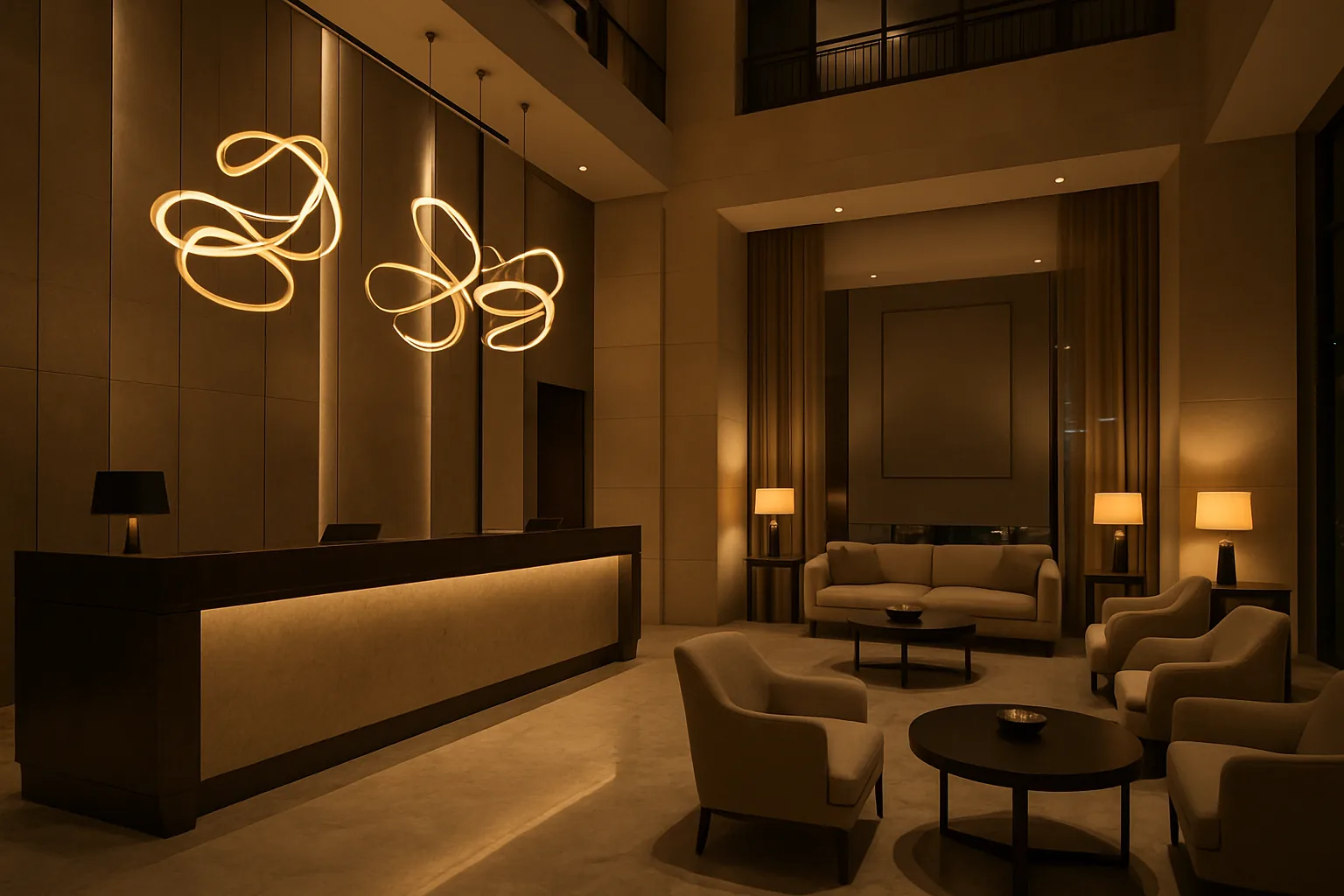
| Lobby | Reception desk, seating clusters, decorative lighting, console tables, decorative accessories |
| F&B | Dining tables, dining chairs, banquettes, bar furniture, bar stools, decorative lighting, soft furnishings |
| Pool / outdoor | Loungers, parasols, side tables, day beds, bar seating, decorative planters |
| Spa / fitness | Treatment beds, lounge seating, lockers, mirrors, lighting |
| Back-of-house | Staff dining furniture, locker furniture, admin office furniture, executive suite furniture |
This is what BSA Trading typically delivers as a turnkey package. Per-key budgets for full-scope FF&E sit in the ranges we cover in our UAE FF&E cost-per-key benchmarks post.
What’s in OS&E
OS&E is broader and more fragmented. Most projects break it into seven sub-categories:
| Category | Typical items |
|---|---|
| Bed linens | Sheets, pillowcases, duvet covers, blankets, mattress protectors, pillow protectors |
| Bath linens | Bath towels, hand towels, face cloths, bath mats, robes, slippers |
| Pool linens | Pool towels, beach towels, beach robes |
| Tabletop | Plates, bowls, cutlery, glassware (water, wine, champagne, cocktail), tea/coffee service, banquet service ware, serving platters |
| Banquet | Chair covers, table linens, runners, napkins, napkin rings, banquet display ware |
| Kitchen | Pots, pans, knives, food prep tools, baking equipment, refrigeration, food warmers, espresso machines, dishwashing, ice machines, butchery equipment |
| Uniforms and operational | Staff uniforms, name badges, room service trolleys, housekeeping carts, luggage trolleys, vacuum cleaners, in-room amenities (notepads, pens, hangers, irons, ironing boards) |
Three sub-categories are quietly expensive: kitchen equipment (especially in full-service hotels with multiple F&B outlets), uniforms (particularly in branded properties with mandated designer uniforms), and tabletop (where operator brand standards dictate specific suppliers).
Sample budget breakdown: 100-key 4-star hotel in Dubai
For a hypothetical 100-key 4-star with two F&B outlets, a small spa, a pool, and standard meeting facilities:
| Line | Total budget (AED) | % of FF&E + OS&E | Per-key (AED) |
|---|---|---|---|
| FF&E — guest rooms | 5,500,000 | 56% | 55,000 |
| FF&E — public areas | 1,800,000 | 18% | 18,000 |
| FF&E — F&B outlets | 950,000 | 10% | 9,500 |
| FF&E — outdoor | 350,000 | 4% | 3,500 |
| FF&E — back-of-house | 250,000 | 3% | 2,500 |
| FF&E subtotal | 8,850,000 | 90% | 88,500 |
| OS&E — linens (bed, bath, pool) | 280,000 | 3% | 2,800 |
| OS&E — tabletop and banquet | 230,000 | 2% | 2,300 |
| OS&E — kitchen equipment | 350,000 | 4% | 3,500 |
| OS&E — uniforms | 120,000 | 1% | 1,200 |
| OS&E — operational and consumables | 160,000 | 2% | 1,600 |
| OS&E subtotal | 1,140,000 | 12% | 11,400 |
| Total FF&E + OS&E | ~10M | 100% | ~100k/key |
OS&E typically runs 10–15% of FF&E for a 4-star hotel; closer to 8–10% for limited-service, and up to 18–20% for luxury due to higher-grade tabletop, linens, and uniforms.
The boundary disputes that cost projects money
Three areas where FF&E and OS&E ambiguity causes real budget overruns:
1. Decorative accessories. Coffee-table books, decorative bowls, vases, flowers, picture frames, candle holders. Specified by the interior designer (so it feels like FF&E), procured by the pre-opening team (so it gets booked as OS&E), and frequently double-counted in both budgets — or missed entirely.
2. Minibar contents. The minibar fridge is FF&E. The bottles inside are OS&E (and inventory). The branded minibar tray and glassware are typically OS&E but often arrive as part of an FF&E package because the interior designer specified them. Get this nailed in the FF&E specification.
3. Lobby music systems and BGM speakers. Audio systems straddle the FF&E / OS&E / MEP boundary. Speakers are usually MEP. The amplifier and source components can be FF&E or OS&E depending on the operator. Decide early.
Procurement timing: why OS&E waits
FF&E procurement starts 14–18 months before opening because of the long lead times we cover in our Turkey and China lead time post. OS&E typically starts 6–9 months before opening for three reasons:
- Storage cost. Linens, uniforms, and tabletop in storage absorb cost without earning revenue.
- Brand standard updates. Operator brand standards on uniforms and tabletop change more frequently than on FF&E. Late procurement minimises the risk of opening with an outdated standard.
- Pre-opening team availability. OS&E is typically procured by the operator’s pre-opening team — General Manager, F&B Director, Executive Housekeeper — who are themselves only mobilised 6–9 months before opening.
This timing offset is why FF&E and OS&E almost always have different procurement leads and different budget ownership inside the development team.
Should you bundle?
Most owners don’t. Some specific cases where bundling makes sense:
- Small properties (under 80 keys) where the procurement overhead of running two parallel processes outweighs the specialisation benefit.
- Branded residences where the OS&E scope is minimal and the FF&E supplier already has the design relationships.
- Repeat owner relationships with a turnkey FF&E supplier who has demonstrated capability across both scopes.
For most 100+ key hotels in the GCC, separate procurement is the right answer. FF&E and OS&E are genuinely different supply chains, with different specialisations, different timing, and different decision-makers on the operator side.
Next step
If you’re building your project budget and want to stress-test the FF&E and OS&E split for your specific scheme, request a budget review. For lead-time planning, see our Turkey and China FF&E lead time post or our hotel pre-opening timeline for the full development calendar.