Hotel Pre-Opening FF&E Timeline: When to Lock Suppliers
A backwards-planned schedule from opening day showing exactly when FF&E specs must be locked, suppliers signed, and first containers shipped to avoid 6-month delays.
The hotel pre-opening calendar is the master schedule that controls everything else. Construction has its own programme, FF&E has its programme, OS&E has its programme, brand approvals have their cycles, marketing and pre-bookings have their commitments — and they all converge on a single fixed date with commercial consequences.
This post lays out the realistic FF&E timeline backwards from opening day, with the milestones that matter, the risk events that compound, and the recovery windows that are still recoverable.
The opening-day countdown
For a 200-key 4-star branded hotel in the GCC, the FF&E procurement and installation programme typically spans 16–18 months from specification lock to opening. The schedule breaks into seven phases:
| Months from opening | Phase | Owner / supplier action |
|---|---|---|
| T-18 to T-15 | Specification | Interior designer locks FF&E spec; tender package issued |
| T-15 to T-13 | Tender | RFP, evaluation, supplier selection, contract |
| T-13 to T-10 | Prototype | Prototype guest room produced, delivered, operator approved |
| T-10 to T-4 | Production | Series production across guest rooms, public areas, F&B |
| T-7 to T-3 | Shipping | Phased shipments from origin to UAE; consolidation |
| T-4 to T-1 | Installation | Phased installation, snagging, defect rectification |
| T-1 to T-0 | Soft opening | Final QC, brand walk-through, opening day |
The dates above assume a Marriott, Hilton, IHG, or Accor branded property. First-of-brand or signature lifestyle properties typically need 2–4 months earlier on each milestone due to extended approval cycles.
T-18 to T-15: specification lock
This is the most under-managed phase of the entire programme. Owners and design teams treat specification as fluid until tender — but every week of fluidity at this stage costs a week of fluidity later, which there is no room for.
What needs to happen:
- Final FF&E specification document with materials, dimensions, finishes, and brand-standard references
- Operator review and informal sign-off on the specification (before tender, not after)
- Schedule of items by location with quantity take-off
- Fire-rating compliance map (we cover the standards in our UAE Civil Defence fire ratings post)
- Tender package with technical specification and commercial terms
What goes wrong:
- Operator brand approval sought after tender starts — leads to spec changes during tender, supplier confusion, and re-pricing
- Decorative accessories left vague — leads to scope disputes during installation
- OS&E items mistakenly included in FF&E scope (or vice versa) — see our FF&E vs OS&E budget breakdown post
T-15 to T-13: tender and award
A tightly run tender for a single-supplier turnkey FF&E contract takes 6–8 weeks. Multi-supplier or unbundled tenders take longer.
What needs to happen:
- RFP issued to a shortlist of qualified suppliers (typically 3–5 for hospitality FF&E)
- Site visit and bidder Q&A session
- Technical and commercial bid submission
- Bid evaluation: technical compliance, commercial competitiveness, programme credibility, financial standing
- Negotiation and contract award
What goes wrong:
- Shortlist includes commodity suppliers without hospitality track record — leads to prototype failures or quality issues during series production
- Insufficient evaluation of supplier programme — the lowest price often comes from the supplier with the most optimistic schedule
- Late operator concerns on the awarded supplier — get operator pre-clearance on the shortlist, not the winner
T-13 to T-10: prototype and approval
The prototype phase is the operational crucible of the entire FF&E programme. Everything before is preparation; everything after depends on it.
What needs to happen:
- Supplier produces full guest-room prototype (sometimes more than one configuration)
- Prototype delivered to UAE for physical review (or, for some operators, factory-side review with photographs)
- Operator brand approval team conducts full review
- Iteration cycles to address operator comments
- Written sign-off on prototype before series production begins
What goes wrong:
- Prototype review compressed to 2 weeks — leads to inadequate review and emerging issues during series production
- Operator team turnover during prototype phase — new approving manager re-opens settled questions
- Material substitutions discovered at prototype — typically driven by supplier sourcing constraints
The realistic prototype-to-approval window is 8–12 weeks. Plan for the longer end.
T-10 to T-4: series production
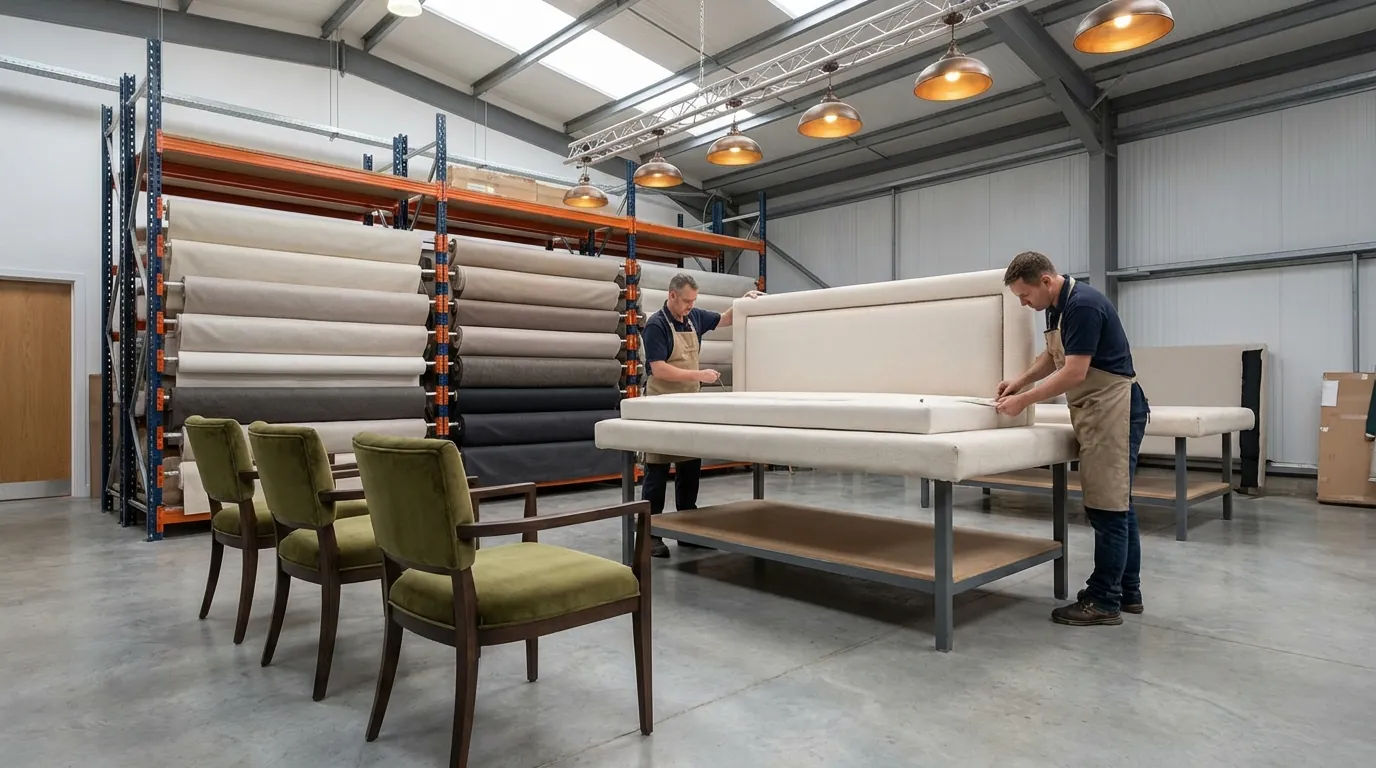
Once prototype is approved, series production begins. For a 200-key project with mixed origins (Turkey + China), production runs in parallel across factories.
What needs to happen:
- Material procurement at scale (hardwood, fabric, hardware)
- Production line setup and tooling commissioning
- Series production with factory QC at scheduled checkpoints
- Pre-shipment inspection (typically by independent third party)
- Container loading at origin
What goes wrong:
- Material shortages on specific veneers, fabrics, or marble varieties — mitigated by approving substitutes at prototype stage
- Factory capacity conflicts with other projects — locked production slots prevent this
- Quality drift after prototype — independent pre-shipment inspection is the discipline
For details on origin-specific lead times, see our Turkey and China lead time post.
T-7 to T-3: shipping and customs
For a 200-key project, FF&E typically ships in 4–8 phased containers from each origin. Phased shipping aligns with the installation sequence on site.
What needs to happen:
- Container booking with carrier (book early to avoid blank sailings)
- Origin port loading and bill of lading issuance
- Sea freight transit (14–28 days depending on origin)
- Destination port arrival, customs clearance, last-mile to site or warehouse
What goes wrong:
- Documentation errors trigger customs holds — the most common FF&E shipping failure mode
- HS code disputes prompt physical inspection — adds 1–3 weeks
- Carrier blank sailings during Chinese New Year and Ramadan — plan loading windows around these
T-4 to T-1: installation and snagging
Installation runs in parallel with the tail end of construction handover. Coordination quality is the single biggest determinant of whether installation runs smoothly or chaotically.
What needs to happen:
- Floor-by-floor or zone-by-zone FF&E installation
- Site QC at installation
- Defect identification and rectification
- Final walk-through with operator brand team
- Operator sign-off on each guest room and public area
What goes wrong:
- Construction delays on adjacent areas prevent FF&E access — leading to peak storage costs
- Installation teams under-resourced for the scale — leading to missed milestones
- Defect rectification supplies (replacement fabrics, replacement hardware) not staged on site — leading to delayed sign-off
The risk events that compound
Six events that consistently push opening dates:
- Late spec change after prototype approval. Forces tooling re-cut and lost production weeks. Recovery: 4–8 weeks at premium cost.
- Operator approval team change mid-programme. New manager re-opens settled questions. Recovery: 2–6 weeks of re-explanation.
- Material supply disruption. Veneer, marble, or speciality fabric becomes unavailable. Recovery: 2–4 weeks if substitute is pre-approved; 6–10 if not.
- Customs documentation error. HS code dispute or missing certificate. Recovery: 1–3 weeks per event.
- Construction handover slip. FF&E ready but site not ready. Recovery: storage cost, no schedule recovery.
- Pre-opening team mobilisation delay. Operator’s GM, F&B Director, Executive Housekeeper not yet on site at FF&E installation. Recovery: depends on item but typically 2–4 weeks of follow-up snagging.
The recovery levers
When milestones slip, three recovery levers exist — in order of cost:
- Compressed installation. Add installation crews. Cost: 1.3–1.5x normal labour rate. Recovers 1–3 weeks.
- Air freight on critical path items. Cost: 8–12x sea freight per cubic metre. Recovers 2–3 weeks per air shipment. Used selectively for critical items only.
- Soft opening compromise. Open with one wing or one floor type complete; complete remainder during operating phase. Cost: revenue impact and brand reputation, but preserves opening date.
The lever rarely available: shifting the opening date itself. Hotel openings are tied to operator agreements and pre-bookings. Slips happen but are commercially expensive.
What “lock the supplier early” actually means
It does not mean signing a PO before specifications are complete — that creates worse problems. It means:
- Selecting the supplier and starting prototype work 12–14 months before opening
- Locking the production slot in their factory schedule so capacity is reserved
- Phasing the PO so deposit secures the slot, with full PO triggered after prototype approval
Most GCC hotel owners now structure FF&E contracts this way. It compresses risk for both parties and removes the worst-case “we cannot start your project for another 4 months” scenario that occurs when major suppliers are booked solid.
Next step
If you have a target opening date and want to validate whether your current FF&E schedule is realistic, send us your room programme and opening date. We deliver backwards-planned production schedules within 5 working days, tied to a real factory slot. For full-scope context, see our hotel FF&E procurement guide.