Stone & Marble · Material specification
Absolute Black Granite Material Specifications
A durable dark natural stone for restaurant tables, counters and high-contact furniture where scratch, heat and visual consistency outperform most marbles.
Current material reference
Dense fine-grained black granite; honed or polished with low visible movement
Material guidance · supplier data required for approval
Material decision summary
Project suitability at a glance.
Choose by porosity, etching and stain risk, support, slab size, edge profile and maintenance—not appearance alone.
Best for
- +Restaurant tables, counters and hard-working dark furniture tops
Avoid when
- −The source, dye/resin treatment or exact slab lot has not been disclosed
- Traffic level
- High
- Maintenance
- Low
- Visual variation
- Medium
- Relative budget
- ●●●○
- Suitable environments
- Interior · High traffic · Food service · Wet area
Material overview
Common material applications
Select by porosity, etching risk, scratch exposure, slab size, edge profile and maintenance capacity—not colour alone. Natural stone requires slab approval; engineered surfaces require current manufacturer data.
Material-specific authority schedule
Ten controls owned by this exact material—not inherited category rows. Final values are confirmed from supplier data, the project sample and shop drawings.
- Declared project reference
- Absolute Black Granite: Dense fine-grained black granite; honed or polished with low visible movement
- Exact material identity
- Dense fine-grained natural black granite with quarry/source, commercial name, finish, resin/fill/dye treatment and slab lot declared.
- Technical system definition
- A dense fine-grained natural black granite selected by verified source and slab lot. Finish, fissures, resin/fill/dye treatment, edge and support complete the furniture system.
- Selection differentiator
- Low visible movement, strong mineral hardness and heat tolerance make it a practical dark natural-stone worktop.
- Critical approval decision
- Verify stone identity and disclose any dye or resin; visual blackness alone cannot distinguish durable granite from treated look-alikes.
- Non-equivalent substitute
- Dyed black stone, black marble, engineered quartz or porcelain is not equivalent in mineral structure, edge and ageing.
- Fabrication focus
- Inspect slabs under strong light, support cut-outs, ease vulnerable edges and colour-match any resin repairs before cutting.
- GCC exposure limit
- Exterior heat is usually tolerated, but dark slabs become hot and incompatible resin/dye or salt can reveal treatment and staining.
- Material-specific care rule
- Use pH-neutral stone cleaner and inspect sealer by performance; avoid oil polish that masks treatment.
- Reject the delivery when
- Reject undisclosed dye, resin blotch, mismatched black tone, open fissure, edge chip, iron staining or slab lot outside control.
Approval pack
Documents required before ordering.
Material guidance · supplier data required for approval
- Absolute Black Granite: Identity/source evidence: Dense fine-grained natural black granite with quarry/source, commercial name, finish, resin/fill/dye treatment and slab lot declared.
- Absolute Black Granite: Signed selection evidence: Supplier declaration and test patch show no undisclosed dye bleed or treatment contrast.
- Absolute Black Granite: Second technical gate: Approved slab dry lay and full edge sample establish appearance and support.
- Absolute Black Granite: Factory close-out: Inspect slabs under strong light, support cut-outs, ease vulnerable edges and colour-match any resin repairs before cutting.
Lead time & availability
Confirmed after source, finish and quantity selection
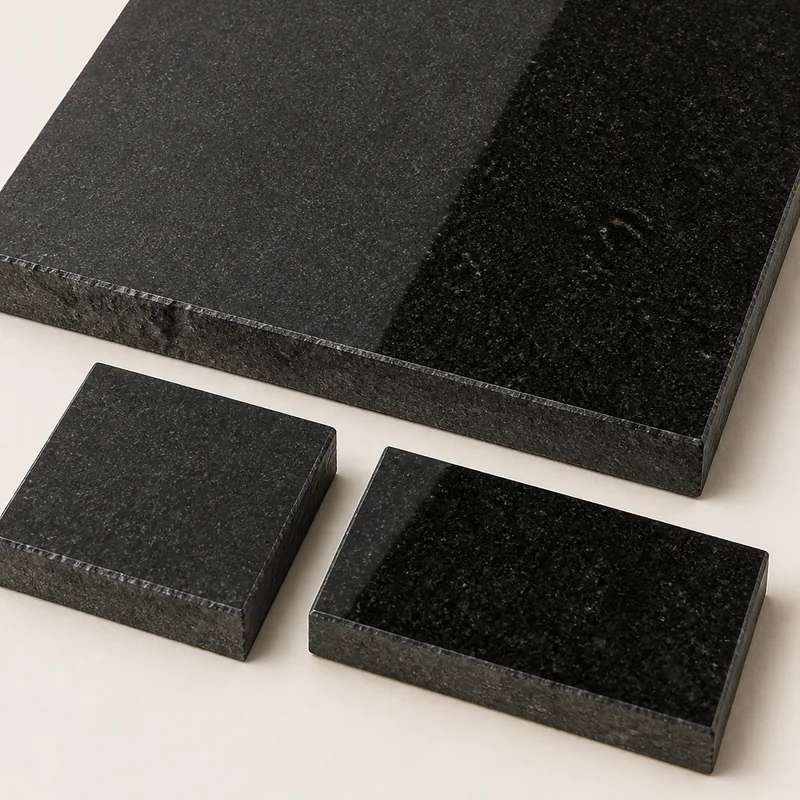
Material specimen views
One physical material sample, shown in four detail views.
Every crop comes from this material specimen itself, with no furniture product shown. The approved sample and current supplier documents govern final colour and construction.
Material identity
What is unique—and what is shared with the family.
The exact material fingerprint comes first. Shared family science is explicitly separated in a collapsible appendix instead of being presented as unique content.
50 material-specific points · 42 shared family references
01 · Material fingerprint
What makes this exact selection technically distinct?
Position in the material family
Natural granite
- Reference that must be declared
- Dense fine-grained natural black granite with quarry/source, commercial name, finish, resin/fill/dye treatment and slab lot declared.
- Selection differentiator
- Low visible movement, strong mineral hardness and heat tolerance make it a practical dark natural-stone worktop.
- Not an equivalent substitute
- Dyed black stone, black marble, engineered quartz or porcelain is not equivalent in mineral structure, edge and ageing.
- Reject the delivery when
- Reject undisclosed dye, resin blotch, mismatched black tone, open fissure, edge chip, iron staining or slab lot outside control.
Shared family reference
Open the shared Stone & Marble engineering appendix
This appendix applies to the complete Stone & Marble family. It is retained as supporting reference and is not counted as unique content for this material.
Shared family reference
Open the shared Stone & Marble engineering appendix
This appendix applies to the complete Stone & Marble family. It is retained as supporting reference and is not counted as unique content for this material.
02 · System anatomy
The material is not a single surface.
A dense fine-grained natural black granite selected by verified source and slab lot. Finish, fissures, resin/fill/dye treatment, edge and support complete the furniture system.
01Surface finish / sealer
Layer function
Polish, hone, texture and impregnator govern appearance, slip, staining and maintenance.
How to verify
Approve finish and sealer together on the exact slab/lot.
02Stone / composite body
Layer function
Mineralogy, porosity, veins, resin, aggregate and manufacturing route control physical behaviour.
How to verify
Identify quarry/lot or manufacturer/product and current physical data.
03Edge / cut-out
Layer function
Profile, radius, lamination and cut-out geometry concentrate impact and bending stress.
How to verify
Full-size detail and shop drawing show all thicknesses, radii and reinforcement.
04Support / fixing
Layer function
Subtop, frame, adhesive, mechanical fixing and movement isolation transfer load safely.
How to verify
Engineer span, point loads, overhang, fixing and transport/installation sequence.
03 · Decision gates
Reference benchmarks and the project rule.
Material identity
01- Reference band
- Natural stone by geological type/quarry/lot, or engineered product by manufacturer and exact reference.
- Project rule
- Marketing colour names are not physical-property declarations.
- Evidence status
- Petrographic/product declaration and traceable lot
Absorption / density
02- Reference band
- Natural-stone route commonly uses ASTM C97 or the project’s stated EN equivalent.
- Project rule
- Compare data only under the same method and conditioning.
- Evidence status
- Current report for representative production
Flexural strength
03- Reference band
- ASTM C880 or stated EN route informs span, overhang, support and cut-out design.
- Project rule
- Engineering must use declared thickness, finish direction and wet/dry condition as relevant.
- Evidence status
- Laboratory result plus furniture engineering
Compressive strength
04- Reference band
- ASTM C170 or stated project route; relevant to bearing and concentrated support but not a substitute for bending design.
- Project rule
- Do not use high compression strength to justify unsupported thin tops.
- Evidence status
- Current test report
Thickness / edge build
05- Reference band
- BSA furniture reference: 20 or 30 mm is common; mitred built-up edges require a drawn section and reinforcement.
- Project rule
- Final thickness follows slab data, span, load, cut-outs and visual intent.
- Evidence status
- Shop drawing, calculation and physical edge sample
Stain / chemical response
06- Reference band
- Stone specific; calcitic marbles can etch from acids even when sealed.
- Project rule
- Trial the project’s coffee, citrus, wine, oil and cleaners on the approved finish.
- Evidence status
- Stain/chemical trial and care matrix
04 · Family comparison
Visually related systems that are not technically equivalent.
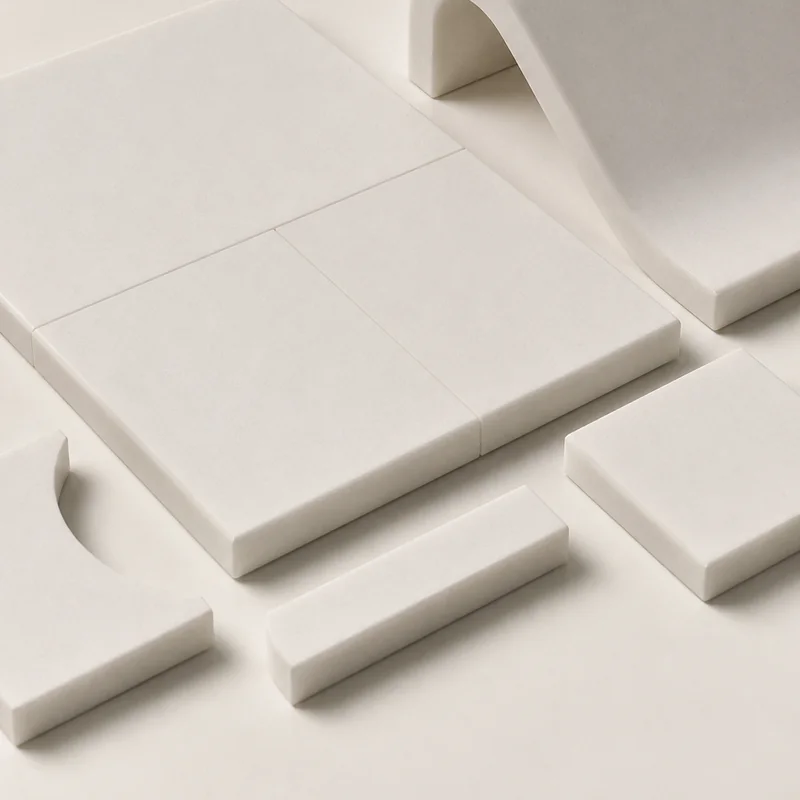
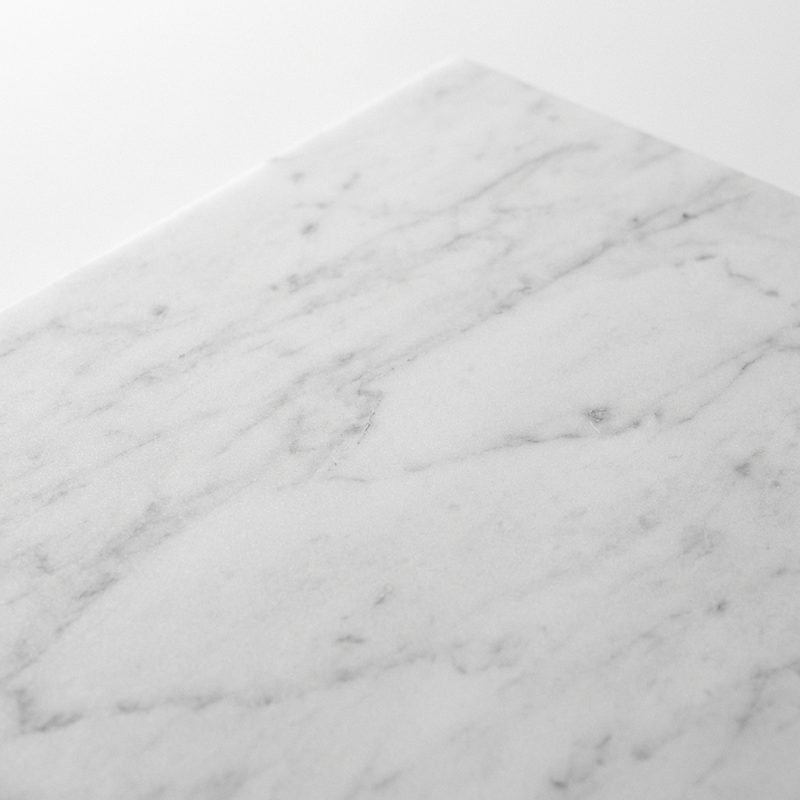
Natural marble
- Best use
- Luxury furniture where vein movement and unique slabs are central to the design.
- Trade-off / constraint
- Acid etching, natural fissures, slab variation and repair expectations require acceptance.
Travertine
- Best use
- Textural tables and casegoods using filled or open pores as a deliberate character.
- Trade-off / constraint
- Fill, voids, edge strength and dirt retention must be controlled.
Terrazzo composite
- Best use
- Repeatable aggregate graphics, custom colour and robust built-up furniture forms.
- Trade-off / constraint
- Matrix chemistry, aggregate distribution, pinholes and repair colour remain batch dependent.
Engineered quartz
- Best use
- Consistent, low-porosity hospitality counters and furniture surfaces.
- Trade-off / constraint
- Heat, UV, resin chemistry, cut-outs and manufacturer fabrication rules still govern.
Natural granite
- Best use
- Hard-wearing restaurant tops and counters where mineral density and heat tolerance matter.
- Trade-off / constraint
- Source, fissures, resin/dye treatment, finish and edge support still require slab-lot approval.
Sintered porcelain slab
- Best use
- Low-porosity repeatable surfaces requiring stain, heat and UV resistance.
- Trade-off / constraint
- Thin-edge impact, cut-outs, printed-face continuity and approved fabrication govern reliability.
Acrylic solid surface
- Best use
- Seamless counters, integrated vanities and thermoformed furniture details.
- Trade-off / constraint
- Heat, scratches, dark-colour joint visibility and subframe support require control.
05 · Factory handbook
Hold points from receiving through production release.
Fabrication focus for this exact material
Inspect slabs under strong light, support cut-outs, ease vulnerable edges and colour-match any resin repairs before cutting.
-
01Slab / lot approval
Control instruction
Photograph, label and review every slab/lot for tone, vein, fissures, resin, fill and defects.
Close-out evidence
Signed slab map with accepted and excluded zones
-
02Dry lay
Control instruction
Arrange all visible pieces at full scale for vein flow, colour balance, mirrored joints and repairs.
Close-out evidence
Numbered dry-lay photograph tied to cutting file
-
03Cutting / reinforcement
Control instruction
Control corner radii, cut-out spacing, mesh/rod reinforcement, water cooling and handling.
Close-out evidence
Cutting drawing and inspected reverse face
-
04Edge fabrication
Control instruction
Match mitres, vein, polish and arris; avoid voids and unsupported cosmetic build-ups.
Close-out evidence
Full-size corner/edge sample and first-off
-
05Support / installation
Control instruction
Verify flatness, full bearing, isolators, adhesive, mechanical restraint and transport lifting points.
Close-out evidence
Pre-close support inspection and installed level check
06 · Climate & operations
GCC exposure matrix and maintenance plan.
Material-specific climate warning
Exterior heat is usually tolerated, but dark slabs become hot and incompatible resin/dye or salt can reveal treatment and staining.
01Guestroom furniture
Preferred- Material response
- Generally manageable with protected finish, coasters and operations guidance.
- Design control
- Select edges/support for luggage impact and housekeeping chemicals.
02Lobby feature table
Conditional- Material response
- Large slab expression is strong, but uncontrolled point loads and sitting create bending risk.
- Design control
- Engineer span, support and misuse loads; approve full dry lay.
03Food & beverage
Conditional- Material response
- Acid, oil, wine, heat and repeated cleaning expose etching and staining.
- Design control
- Choose finish/material by trials and issue a rapid spill protocol.
04Vanity / wet area
Conditional- Material response
- Standing water, cosmetics and wet cut-outs attack sealer, adhesive and metal support.
- Design control
- Seal cut-outs, provide drainage and use compatible corrosion-resistant support.
05Window / high heat
Conditional- Material response
- Thermal gradients and dark colour can stress slabs and resin-bound products.
- Design control
- Confirm manufacturer temperature/UV limits and avoid local hot spots.
06Exterior coastal
Avoid- Material response
- Salt, moisture, thermal cycling and anchorage exposure require project engineering and tested durability.
- Design control
- Do not extrapolate an interior furniture approval to exterior use.
Operational maintenance plan
Material-specific care rule
Use pH-neutral stone cleaner and inspect sealer by performance; avoid oil polish that masks treatment.
-
01Daily
Action
Remove grit, wipe with pH-neutral approved cleaner and dry standing water.
Prohibited
No acidic, alkaline or abrasive cleaner by default.
-
02After a spill
Action
Blot immediately; neutralise only according to the stone/sealer care matrix.
Prohibited
Do not assume sealer prevents acid etching.
-
03Monthly
Action
Inspect edges, mitres, cut-outs, fissures, fill, support movement and sealer response.
Prohibited
Do not fill a moving crack before diagnosing support.
-
04Sealer review
Action
Test water behaviour and reapply only with compatible product after proper preparation.
Prohibited
No fixed annual promise without material/use evidence.
-
05Repair
Action
Use retained material and a stone specialist for chips, resin/fill and polish matching.
Prohibited
Do not disguise structural cracking as cosmetic resin repair.
07 · Reference library
The language that governs the decision—and where it comes from.
Material glossary
- 01Dry lay
- Full-scale arrangement of cut pieces before installation to approve vein and colour continuity.
- 02Fissure
- A natural separation along mineral boundaries; its significance depends on location, depth and reinforcement.
- 03Mitred edge
- Thin slabs joined at an angle to create the appearance of a thicker edge.
- 04Impregnating sealer
- A penetrating treatment intended to reduce absorption without forming a thick surface film.
- 05Etching
- Chemical attack that dulls a calcitic polished/honed surface; it is different from a stain.
Professional and standards sources
- 01
Natural Stone Institute
Dimension Stone Design Manual
Industry reference covering stone data, furniture, countertops, detailing, installation and maintenance.
Open primary source ↗ - 02
Natural Stone Institute
ASTM standards for natural stone
Selection route for absorption, strength, flexure, abrasion and anchorage methods.
Open primary source ↗ - 03
ASTM
Committee C18 dimension stone methods
Official ASTM committee scope and current dimension-stone methods.
Open primary source ↗ - 04
Natural Stone Institute
Natural stone testing services
Method list for absorption, compression, flexure, stains, chemicals and cycling.
Open primary source ↗
Material-specific technical dossier
Absolute Black Granite controls from decision to production.
Every row below is tied to this material’s identity, differentiator, fabrication, exposure or care route; no generic family rows are included in this dossier.
8 unique controls · 4 contextual test applications · 5 material-specific risks
System definition
A dense fine-grained natural black granite selected by verified source and slab lot. Finish, fissures, resin/fill/dye treatment, edge and support complete the furniture system.
Critical decision
Verify stone identity and disclose any dye or resin; visual blackness alone cannot distinguish durable granite from treated look-alikes.
01 · Selection variables
What the material schedule must lock.
01Absolute Black Granite: Source and treatment
- What must be declared
- Quarry/source, geological identity, commercial name, resin, fill, mesh, dye and sealer
- Approval basis
- Supplier declaration and test patch show no undisclosed dye bleed or treatment contrast.
02Absolute Black Granite: Slab, edge and support
- What must be declared
- Crystal size, tone, fissures, thickness, cut-outs, edge profile, reinforcement and subframe bearing
- Approval basis
- Approved slab dry lay and full edge sample establish appearance and support.
03Absolute Black Granite: identity declaration
- What must be declared
- Dense fine-grained natural black granite with quarry/source, commercial name, finish, resin/fill/dye treatment and slab lot declared.
- Approval basis
- Verify stone identity and disclose any dye or resin; visual blackness alone cannot distinguish durable granite from treated look-alikes.
04Absolute Black Granite: equivalency boundary
- What must be declared
- Low visible movement, strong mineral hardness and heat tolerance make it a practical dark natural-stone worktop.
- Approval basis
- Dyed black stone, black marble, engineered quartz or porcelain is not equivalent in mineral structure, edge and ageing.
05Absolute Black Granite: factory execution
- What must be declared
- Inspect slabs under strong light, support cut-outs, ease vulnerable edges and colour-match any resin repairs before cutting.
- Approval basis
- Supplier declaration and test patch show no undisclosed dye bleed or treatment contrast.
06Absolute Black Granite: GCC exposure control
- What must be declared
- Exterior heat is usually tolerated, but dark slabs become hot and incompatible resin/dye or salt can reveal treatment and staining.
- Approval basis
- Release only when the project detail and maintenance route close this exact exposure risk for Absolute Black Granite.
07Absolute Black Granite: operational care route
- What must be declared
- Use pH-neutral stone cleaner and inspect sealer by performance; avoid oil polish that masks treatment.
- Approval basis
- Issue a named cleaning and repair method for Absolute Black Granite; generic family care is not approval.
08Absolute Black Granite: delivery rejection boundary
- What must be declared
- Reject undisclosed dye, resin blotch, mismatched black tone, open fissure, edge chip, iron staining or slab lot outside control.
- Approval basis
- The signed sample, first-off item and delivery inspection must all close this rejection condition for Absolute Black Granite.
| Variable | What must be declared | Approval basis |
|---|---|---|
| 01Absolute Black Granite: Source and treatment | Quarry/source, geological identity, commercial name, resin, fill, mesh, dye and sealer | Supplier declaration and test patch show no undisclosed dye bleed or treatment contrast. |
| 02Absolute Black Granite: Slab, edge and support | Crystal size, tone, fissures, thickness, cut-outs, edge profile, reinforcement and subframe bearing | Approved slab dry lay and full edge sample establish appearance and support. |
| 03Absolute Black Granite: identity declaration | Dense fine-grained natural black granite with quarry/source, commercial name, finish, resin/fill/dye treatment and slab lot declared. | Verify stone identity and disclose any dye or resin; visual blackness alone cannot distinguish durable granite from treated look-alikes. |
| 04Absolute Black Granite: equivalency boundary | Low visible movement, strong mineral hardness and heat tolerance make it a practical dark natural-stone worktop. | Dyed black stone, black marble, engineered quartz or porcelain is not equivalent in mineral structure, edge and ageing. |
| 05Absolute Black Granite: factory execution | Inspect slabs under strong light, support cut-outs, ease vulnerable edges and colour-match any resin repairs before cutting. | Supplier declaration and test patch show no undisclosed dye bleed or treatment contrast. |
| 06Absolute Black Granite: GCC exposure control | Exterior heat is usually tolerated, but dark slabs become hot and incompatible resin/dye or salt can reveal treatment and staining. | Release only when the project detail and maintenance route close this exact exposure risk for Absolute Black Granite. |
| 07Absolute Black Granite: operational care route | Use pH-neutral stone cleaner and inspect sealer by performance; avoid oil polish that masks treatment. | Issue a named cleaning and repair method for Absolute Black Granite; generic family care is not approval. |
| 08Absolute Black Granite: delivery rejection boundary | Reject undisclosed dye, resin blotch, mismatched black tone, open fissure, edge chip, iron staining or slab lot outside control. | The signed sample, first-off item and delivery inspection must all close this rejection condition for Absolute Black Granite. |
02 · Verification
Test and evidence matrix.
Test methods are not compliance certificates or automatic pass values. The project must state the method, required result, tested construction and current report it will accept.
ASTM C97/C97M-25
01- What it measures
- Absorption and bulk specific gravity of dimension stone.
- How to use it here
- Use representative source/lot data to judge porosity, sealing and wet-service risk. Material-specific acceptance for Absolute Black Granite: Supplier declaration and test patch show no undisclosed dye bleed or treatment contrast.
ASTM C170/C170M-24a
02- What it measures
- Compressive strength of dimension stone.
- How to use it here
- Review where concentrated support, pedestal bearing or fixing loads are material. Material-specific acceptance for Absolute Black Granite: Approved slab dry lay and full edge sample establish appearance and support.
ASTM C880/C880M-25
03- What it measures
- Flexural strength of dimension stone.
- How to use it here
- Coordinate result with actual thickness, span, cut-outs, vein direction and support. Material-specific acceptance for Absolute Black Granite: Require treatment disclosure and test heat, solvent and project cleaner on the slab lot.
Project stain/etch mock-up
04- What it measures
- Project-specific exposure of the approved finish and sealer to representative food, drink and cleaning agents.
- How to use it here
- Record substances, dwell time, cleaning method and visual acceptance under project lighting. Material-specific acceptance for Absolute Black Granite: Inspect slabs under strong light, support cut-outs, ease vulnerable edges and colour-match any resin repairs before cutting.
03 · Performance
Failure-mode and control register.
01Absolute Black Granite: Black tone blooms, stains or reveals treatment
- Likely cause
- Undisclosed dye/resin reacts with heat, solvent, UV or cleaner; sealer is uneven.
- Preventive control
- Require treatment disclosure and test heat, solvent and project cleaner on the slab lot.
02Absolute Black Granite: non-equivalent substitution accepted
- Likely cause
- Dyed black stone, black marble, engineered quartz or porcelain is not equivalent in mineral structure, edge and ageing.
- Preventive control
- Dense fine-grained natural black granite with quarry/source, commercial name, finish, resin/fill/dye treatment and slab lot declared.
03Absolute Black Granite: material signature lost in fabrication
- Likely cause
- The workshop route does not implement the material-specific fabrication focus: Inspect slabs under strong light, support cut-outs, ease vulnerable edges and colour-match any resin repairs before cutting.
- Preventive control
- Approved slab dry lay and full edge sample establish appearance and support.
04Absolute Black Granite: GCC exposure mismatch
- Likely cause
- Exterior heat is usually tolerated, but dark slabs become hot and incompatible resin/dye or salt can reveal treatment and staining.
- Preventive control
- Re-detail, relocate or reject Absolute Black Granite where the stated exposure cannot be controlled.
05Absolute Black Granite: cleaning or maintenance damage
- Likely cause
- Use pH-neutral stone cleaner and inspect sealer by performance; avoid oil polish that masks treatment.
- Preventive control
- Train operations on the named care route and retain a signed repair reference for Absolute Black Granite.
| Failure mode | Likely cause | Preventive control |
|---|---|---|
| 01Absolute Black Granite: Black tone blooms, stains or reveals treatment | Undisclosed dye/resin reacts with heat, solvent, UV or cleaner; sealer is uneven. | Require treatment disclosure and test heat, solvent and project cleaner on the slab lot. |
| 02Absolute Black Granite: non-equivalent substitution accepted | Dyed black stone, black marble, engineered quartz or porcelain is not equivalent in mineral structure, edge and ageing. | Dense fine-grained natural black granite with quarry/source, commercial name, finish, resin/fill/dye treatment and slab lot declared. |
| 03Absolute Black Granite: material signature lost in fabrication | The workshop route does not implement the material-specific fabrication focus: Inspect slabs under strong light, support cut-outs, ease vulnerable edges and colour-match any resin repairs before cutting. | Approved slab dry lay and full edge sample establish appearance and support. |
| 04Absolute Black Granite: GCC exposure mismatch | Exterior heat is usually tolerated, but dark slabs become hot and incompatible resin/dye or salt can reveal treatment and staining. | Re-detail, relocate or reject Absolute Black Granite where the stated exposure cannot be controlled. |
| 05Absolute Black Granite: cleaning or maintenance damage | Use pH-neutral stone cleaner and inspect sealer by performance; avoid oil polish that masks treatment. | Train operations on the named care route and retain a signed repair reference for Absolute Black Granite. |
04 · Tender-ready
Copy-ready specification clause.
Provide natural Absolute Black or approved black granite with verified quarry/source, geological/commercial identity, slab lot and finish declared. Disclose all resin, fill, mesh, dye and sealer treatments. Submit relevant absorption/strength data, treatment/cleaner compatibility, slab photographs/dry lay, thickness, cut-out reinforcement, edge and support drawings. Approve exact slabs plus a full-size edge and treatment test; dyed look-alikes, black marble and engineered surfaces are not equivalent.
05 · Quality control
Inspection plan from submittal to handover.
01Absolute Black Granite: identity and source
- Inspection
- Dense fine-grained natural black granite with quarry/source, commercial name, finish, resin/fill/dye treatment and slab lot declared.
- Acceptance / hold point
- Documents, labels and physical material all identify the same Absolute Black Granite construction and source.
02Absolute Black Granite: control sample
- Inspection
- Low visible movement, strong mineral hardness and heat tolerance make it a practical dark natural-stone worktop.
- Acceptance / hold point
- Supplier declaration and test patch show no undisclosed dye bleed or treatment contrast.
03Absolute Black Granite: first-off fabrication
- Inspection
- Inspect slabs under strong light, support cut-outs, ease vulnerable edges and colour-match any resin repairs before cutting.
- Acceptance / hold point
- Approved slab dry lay and full edge sample establish appearance and support.
04Absolute Black Granite: exposure and care trial
- Inspection
- Exterior heat is usually tolerated, but dark slabs become hot and incompatible resin/dye or salt can reveal treatment and staining. Use pH-neutral stone cleaner and inspect sealer by performance; avoid oil polish that masks treatment.
- Acceptance / hold point
- Require treatment disclosure and test heat, solvent and project cleaner on the slab lot.
05Absolute Black Granite: delivery release
- Inspection
- Reject undisclosed dye, resin blotch, mismatched black tone, open fissure, edge chip, iron staining or slab lot outside control.
- Acceptance / hold point
- Absolute Black Granite is released only when no stated rejection condition is present and the signed reference remains traceable.
| Stage | Inspection | Acceptance / hold point |
|---|---|---|
| 01Absolute Black Granite: identity and source | Dense fine-grained natural black granite with quarry/source, commercial name, finish, resin/fill/dye treatment and slab lot declared. | Documents, labels and physical material all identify the same Absolute Black Granite construction and source. |
| 02Absolute Black Granite: control sample | Low visible movement, strong mineral hardness and heat tolerance make it a practical dark natural-stone worktop. | Supplier declaration and test patch show no undisclosed dye bleed or treatment contrast. |
| 03Absolute Black Granite: first-off fabrication | Inspect slabs under strong light, support cut-outs, ease vulnerable edges and colour-match any resin repairs before cutting. | Approved slab dry lay and full edge sample establish appearance and support. |
| 04Absolute Black Granite: exposure and care trial | Exterior heat is usually tolerated, but dark slabs become hot and incompatible resin/dye or salt can reveal treatment and staining. Use pH-neutral stone cleaner and inspect sealer by performance; avoid oil polish that masks treatment. | Require treatment disclosure and test heat, solvent and project cleaner on the slab lot. |
| 05Absolute Black Granite: delivery release | Reject undisclosed dye, resin blotch, mismatched black tone, open fissure, edge chip, iron staining or slab lot outside control. | Absolute Black Granite is released only when no stated rejection condition is present and the signed reference remains traceable. |
Required approval evidence
- +Absolute Black Granite: Identity/source evidence: Dense fine-grained natural black granite with quarry/source, commercial name, finish, resin/fill/dye treatment and slab lot declared.
- +Absolute Black Granite: Signed selection evidence: Supplier declaration and test patch show no undisclosed dye bleed or treatment contrast.
- +Absolute Black Granite: Second technical gate: Approved slab dry lay and full edge sample establish appearance and support.
- +Absolute Black Granite: Factory close-out: Inspect slabs under strong light, support cut-outs, ease vulnerable edges and colour-match any resin repairs before cutting.
- +Absolute Black Granite: Exposure and care record: Exterior heat is usually tolerated, but dark slabs become hot and incompatible resin/dye or salt can reveal treatment and staining. Use pH-neutral stone cleaner and inspect sealer by performance; avoid oil polish that masks treatment.
- +Absolute Black Granite: Delivery rejection record: Reject undisclosed dye, resin blotch, mismatched black tone, open fissure, edge chip, iron staining or slab lot outside control.
Questions to close before approval
- 01Absolute Black Granite: Has the exact identity been declared and evidenced: Dense fine-grained natural black granite with quarry/source, commercial name, finish, resin/fill/dye treatment and slab lot declared?
- 02Absolute Black Granite: Which project requirement makes this differentiator necessary: Low visible movement, strong mineral hardness and heat tolerance make it a practical dark natural-stone worktop?
- 03Absolute Black Granite: Has the team excluded the non-equivalent route: Dyed black stone, black marble, engineered quartz or porcelain is not equivalent in mineral structure, edge and ageing?
- 04Absolute Black Granite: How will the factory prove this execution control: Inspect slabs under strong light, support cut-outs, ease vulnerable edges and colour-match any resin repairs before cutting?
- 05Absolute Black Granite: Can the project control this GCC exposure: Exterior heat is usually tolerated, but dark slabs become hot and incompatible resin/dye or salt can reveal treatment and staining?
- 06Absolute Black Granite: Who owns this operating rule after handover: Use pH-neutral stone cleaner and inspect sealer by performance; avoid oil polish that masks treatment?
Material specimen detail
Absolute Black Granite as a physical material sample.
This specimen view focuses on the surface, edge and construction of Absolute Black Granite. No furniture product is presented here; the approved physical sample remains the reference for final colour, texture and finish.
Project notes
From sample to production.
01
What to specify
Select by porosity, etching risk, scratch exposure, slab size, edge profile and maintenance capacity—not colour alone. Natural stone requires slab approval; engineered surfaces require current manufacturer data.
02
Fabrication & detailing
Template after supporting frames are verified. Provide continuous support, isolate stone from metal stress points, radius internal corners and coordinate cut-outs, fixings and lifting strategy before fabrication.
03
Colour & finish approval
Every natural slab is unique. Slab photography or physical approval is required before cutting, with vein direction coordinated across adjacent furniture components.
04
Care & maintenance
Use pH-neutral stone cleaner and wipe spills promptly. Avoid acidic or abrasive products on natural stone; reseal at intervals established by use and sealer performance.
Specification note
This page is a preliminary material-specification guide. Current product data, test reports, the physical material sample and the intended application system must be approved for each project before ordering or manufacture.
Related materials