Custom Majlis Seating for Hotels, Palaces, and Villas
Floor majlis and majlis sofa dimensions, layout and protocol rules, sadu and contract fabrics, and the mock-up process for GCC hotels, palaces, and villas.
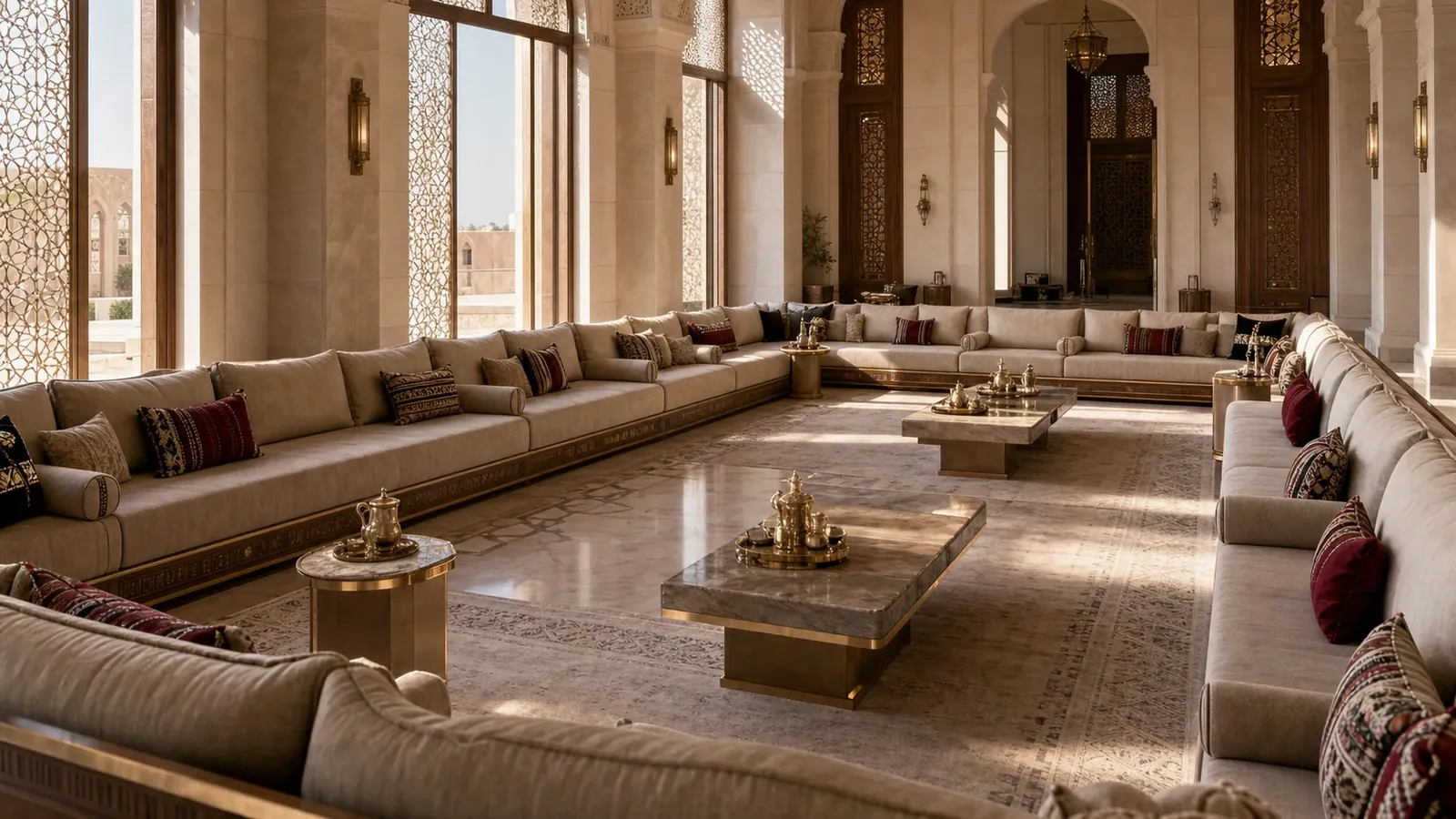
Majlis seating is the one furniture category where a GCC project cannot lean on international contract catalogues. The majlis is a specific social institution with its own layout logic, proportions, and etiquette, recognised by UNESCO since December 2015 as intangible cultural heritage across the UAE, Saudi Arabia, Oman, and Qatar. Get the furniture right and the room works the way its users expect; get it wrong and no amount of finish quality rescues it. This guide covers what specifiers, palace project teams, and hotel owners need to know before commissioning one.
The commercial relevance is growing, not shrinking. Every villa brief in the UAE includes at least one majlis. Palace and government hospitality projects turn on it. And hotels across the Gulf are adding majlis spaces to lobbies, royal suites, and VIP lounges because Gulf-national guests, the region’s highest-value segment, read a well-executed majlis as respect and a token gesture as the opposite.
Professional rule: a majlis is specified as a room, not as a set of sofas. Seating run in linear metres, guest capacity, service circulation, and protocol positions come first; the individual furniture pieces are derived from that plan, never chosen ahead of it.
The three majlis formats
Majlis seating today spans three distinct formats, and the first specification decision is which one the client actually wants. Asking this question late is the most common cause of rejected furniture in this category.
| Format | Seat height | Construction | Where it is chosen |
|---|---|---|---|
| Traditional floor majlis | Floor level, 10–20 cm foam base | Upholstered mattress modules with loose backrest and armrest cushions against the wall | Heritage settings, Ramadan majlis, traditional villa rooms, cultural venues |
| Low-profile majlis sofa | 35–40 cm | Timber or metal frame, deep seat, low back, continuous runs | Modern villas, palace family majlis, hotel majlis lounges |
| Contemporary majlis sofa | 42–45 cm | Standard sofa construction built to majlis layout logic | Hotels, offices, VIP airport facilities, majlis for elderly users |
Floor majlis modules follow well-established proportions: 190 to 200 cm long, 70 to 75 cm deep, with firm foam bases from 10 cm in traditional rooms up to 20 cm in more luxurious interpretations. Backrest cushions lean against the wall or a joinery rail; cylindrical or rectangular armrest cushions (masnad) punctuate the run and give each guest a defined position.
Two practical notes from supply experience. First, mixed-age households usually need mixed formats: a traditional floor majlis for the older generation and formal occasions, and sofa-height seating nearby. Second, when in doubt on a palace or government project, present both a floor and a low-sofa option at mock-up stage; the choice is cultural and personal, and it belongs to the client, not the designer.
Layout rules that are not optional
The majlis layout follows from how the room is used: guests are received, seated in relation to the host, and served coffee in a fixed sequence. The furniture plan has to support that.
- Continuous perimeter seating. Seating runs along the walls in a U or full perimeter, with no gaps that strand a guest and no single chairs isolated from the run. The centre stays open.
- Everyone faces the room. There are no seating backs to other guests. This is why sectionals designed for TV-facing living rooms fail as majlis furniture regardless of quality.
- Equal seat height throughout. No guest sits meaningfully higher or lower than another. Where a host position is emphasised, it is done through placement, armrests, or a subtle break in the run, not elevation.
- The host position anchors the room. The head of the majlis, typically facing or in clear view of the entrance, belongs to the host, with the principal guest seated beside it. The furniture must make this position legible without exaggerating it.
- Capacity is counted in linear metres. Allow roughly 60 to 75 cm of seating run per guest for formal capacity. A 30-guest majlis therefore needs 18 to 22 linear metres of seating before doors, windows, and joinery are considered, which is why majlis rooms are large and why furniture is ordered by the run, not by the piece.
- Service circulation is part of the plan. Coffee and tea service moves around the room continuously. Keep a clear path in front of the entire seating run and place a side table within reach of every two to three seats for cups and dates.
Fabric: where the identity lives
Frames make a majlis comfortable; fabric makes it a majlis. The traditional reference is Bedouin weaving, above all sadu, the geometric ground-loom textile tradition in black, red, beige, and brown that carries its own UNESCO heritage recognition. Contemporary majlis schemes draw on that vocabulary in three ways: genuine woven patterns used on accent cushions and armrests, jacquards that reinterpret sadu geometry at upholstery scale, and quiet neutral schemes in velvet or bouclé where the heritage reference is carried by a single band or border.
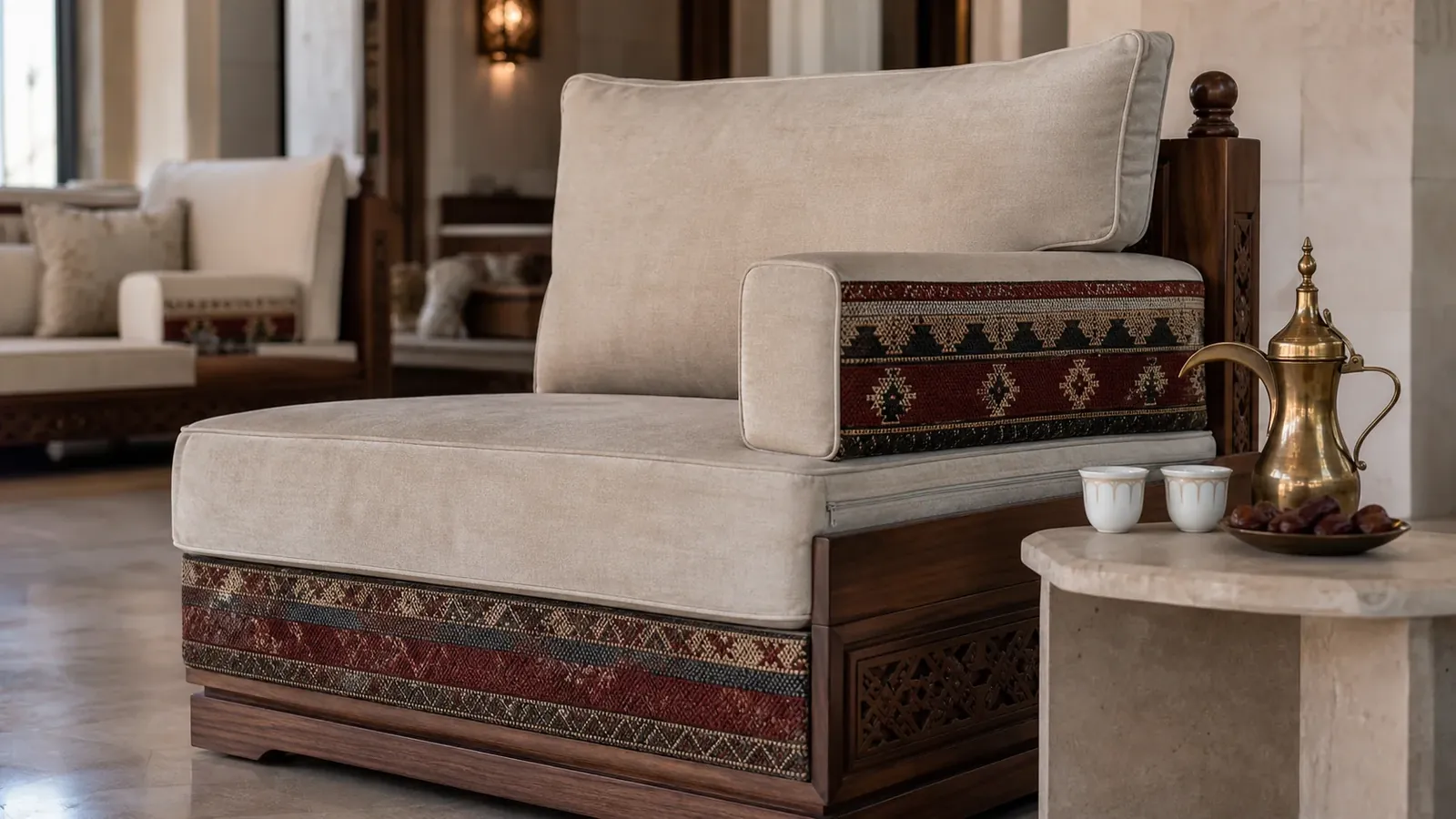
The quantities are the trap. A wall-to-wall majlis consumes fabric at a rate that surprises teams used to specifying individual sofas; 20 metres of seating run with backrests, armrests, and scatter cushions can absorb 150 to 250 linear metres of fabric once pattern matching is included. Three consequences follow. Confirm fabric stock or mill lead time before promising a completion date. Order cutting reserves from the same dye batch, because majlis covers get cleaned hard and replaced piecemeal. And insist on removable, zipped covers on every loose cushion; in a room used nightly for coffee service, this is a running-cost decision, not a convenience.
For hotels and any licensed venue there is a fourth consequence: every one of those metres must be fire-certified contract fabric, with foam and interliners to match. The applicable tests and certificates are covered in our guide to UAE Civil Defence fire ratings for hotel furniture. Residential palace work is not subject to the same licensing, but on large palace projects we recommend specifying to the same standard anyway; the cost difference is small and the client is buying decades of use.
Men’s majlis, women’s majlis, Ramadan majlis
Most private majlis programs are paired: a men’s majlis near the entrance, reachable without passing through family space, and a women’s majlis deeper in the plan. The furniture logic is identical; the briefs usually differ in palette and formality, and the two rooms are best presented as separate fabric schemes on one frame program so the household reads as one project rather than two purchases.
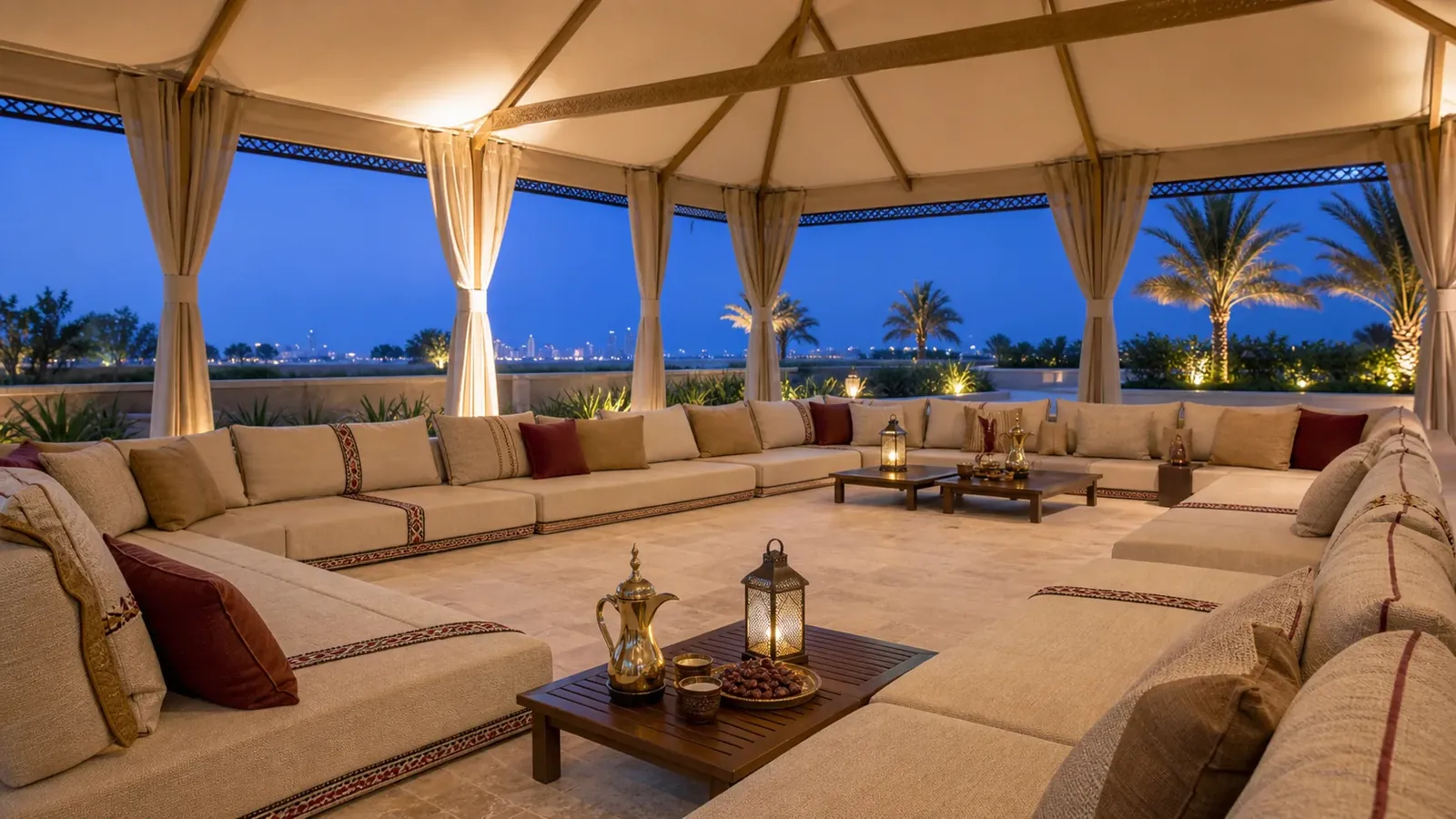
The Ramadan majlis is its own case. Households and hotels alike erect seasonal majlis setups, often in tents or on terraces, used intensively for a month and stored for eleven. Floor majlis sets suit this perfectly, provided they are specified for it: covers that survive repeated cleaning, foam that tolerates compression storage, and outdoor-rated construction for any terrace or tent position that is effectively outdoors. A hotel that owns a well-made Ramadan majlis inventory redeploys it every year; one that improvises with banquet furniture repeats the cost annually and looks like it did.
The majlis in hotel programs
Hotels use majlis seating in more places than the obvious lobby corner: royal and presidential suites, VIP and diplomatic lounges, ballroom pre-function areas during national occasions, and dedicated majlis rooms attached to F&B or conference facilities. Two specification points matter in the hotel context.
First, durability class. A suite majlis sees moderate use; a lobby majlis is public-area furniture and needs contract construction, cleanable fabric, and a cover-replacement plan like any other high-traffic piece; our guide to hotel lobby furniture in Dubai covers the surrounding public-area logic. Second, brand review. International operators review FF&E against brand standards, and a majlis concept presented with proper drawings, fabric certificates, and a mock-up photograph passes design review in one round; a catalogue collage does not.
Palace and VIP work: joinery, carving, and site reality
At palace level, majlis seating stops being loose furniture and becomes architecture. Seating platforms integrate with wall joinery, backrests build into panelled walls, and frames carry carving, gilding, or matched veneers coordinated with doors and ceilings. Three process rules keep this work on track:
- Measure the built room, not the drawing. Long continuous seating runs amplify every site tolerance; a 20-metre run built to architect’s dimensions will not fit the plastered room. Survey after finishes, then produce shop drawings.
- Approve a full-size mock-up seat. One complete module with final foam, final fabric, and final frame finish, sat on by the client. Foam firmness is personal, majlis sitting postures vary, and this single gate prevents the expensive outcome of a beautiful room nobody finds comfortable.
- Sequence with the fit-out. Integrated majlis seating installs alongside joinery and flooring trades, not after handover. Late furniture in this category means visible scribing and filler pieces.
The production route for this class of work, from drawings and samples through QC and delivery, follows the process described in our guide to custom furniture manufacturing for UAE projects.
Comfort engineering: what makes long sitting work
A majlis session lasts hours, and the furniture is judged on hour three. The construction targets differ from a standard sofa: seat foam around 35 to 40 kg/m³ high-resilience grade, firmer than typical retail seating, because soft foam collapses under long static sitting; floor majlis bases firmer still; generous seat depth of 65 to 80 cm with loose back cushions so both upright formal sitting and relaxed reclining work; and armrest cushions positioned so every guest has one within reach, since they define personal space along a continuous run. Springs or elastic webbing should be specified for the actual loading of perimeter seating, where guests habitually sit in the same positions and wear concentrates at the run’s most-used stretch, usually nearest the host.
BSA majlis furniture supply
BSA Trading manufactures custom majlis seating for hotels, palaces, villas, and government facilities across the UAE, Saudi Arabia, Qatar, and the wider GCC. The scope covers traditional floor majlis sets, low-profile and contemporary majlis sofas, joinery-integrated palace seating, carved and finished frames, matching coffee and side tables, and complete fabric programs including sadu-inspired weaves and fire-certified contract options from our seating collections. Every majlis project runs through site survey, shop drawings, fabric approval, and a full-size mock-up seat before production.