Hotel Furniture Supplier in Dubai: FF&E Spec Guide
A detailed guide for hotel owners, designers, and procurement teams specifying hotel furniture in Dubai, covering guest rooms, lobbies, F&B, outdoor areas, materials, fire ratings, samples, lead times, and supplier checks.
The professional answer is simple: a hotel furniture supplier in Dubai should not be selected from images alone. The right supplier must understand drawings, prototypes, fire ratings, room matrices, freight, site access, operator approvals, and the way a hotel will actually be used after opening.
Hotel furniture is not normal furniture placed inside a hotel. A guest room chair is dragged, cleaned, stained, and sat in by hundreds of guests a year. A lobby sofa carries luggage, coffee, children, business meetings, and group arrivals. A restaurant chair can turn over three times a day. A pool lounger faces UV, humidity, chlorine, and sunscreen. The supplier must specify for that reality.
This guide is written for hotel owners, designers, project managers, and procurement teams preparing to source hotel furniture or a full FF&E package in Dubai, Abu Dhabi, Ras Al Khaimah, Qatar, Saudi Arabia, or the wider GCC.
Specifier’s rule: if the supplier cannot discuss construction, finish protection, fabric performance, fire-rating documents, packing, replacement parts, and installation sequence, they are selling furniture, not managing hotel FF&E.
What a hotel furniture package really covers
Hotel furniture should be organized by operating area, not by a generic product list. The quotation and production schedule should follow the hotel zones:
| Area | Typical furniture | What usually goes wrong |
|---|---|---|
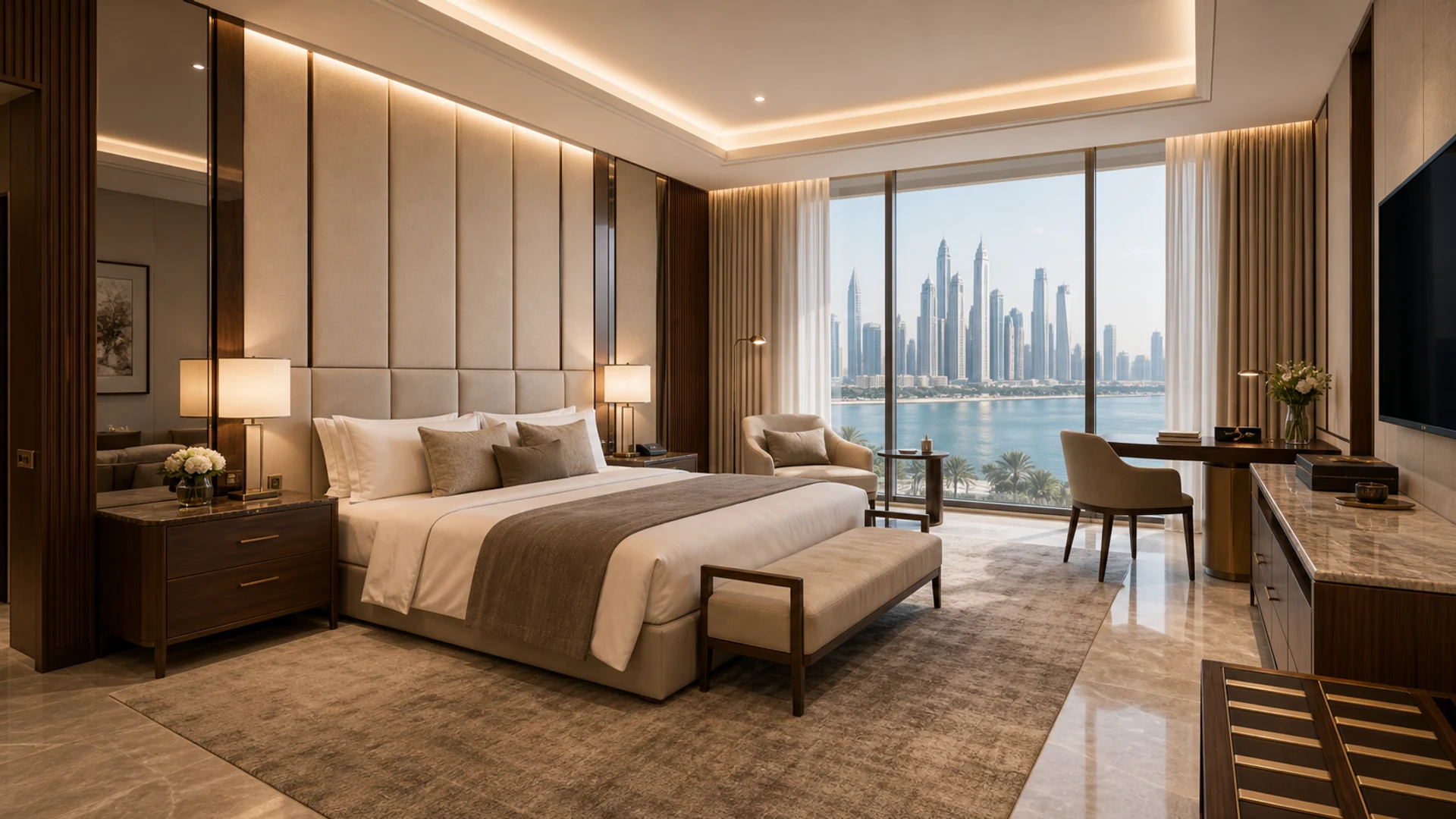
| Guest rooms | Beds, headboards, nightstands, desks, wardrobes, luggage benches, TV units, mirrors, lounge chairs | Late prototype approval, weak casegoods, poor socket coordination |
| Suites | Living sofas, dining tables, lounge chairs, sideboards, desks, bedroom furniture | Residential look with non-contract durability |
| Lobby | Reception counters, concierge desks, sofas, armchairs, coffee tables, planters, screens | Beautiful layout that blocks luggage and guest flow |
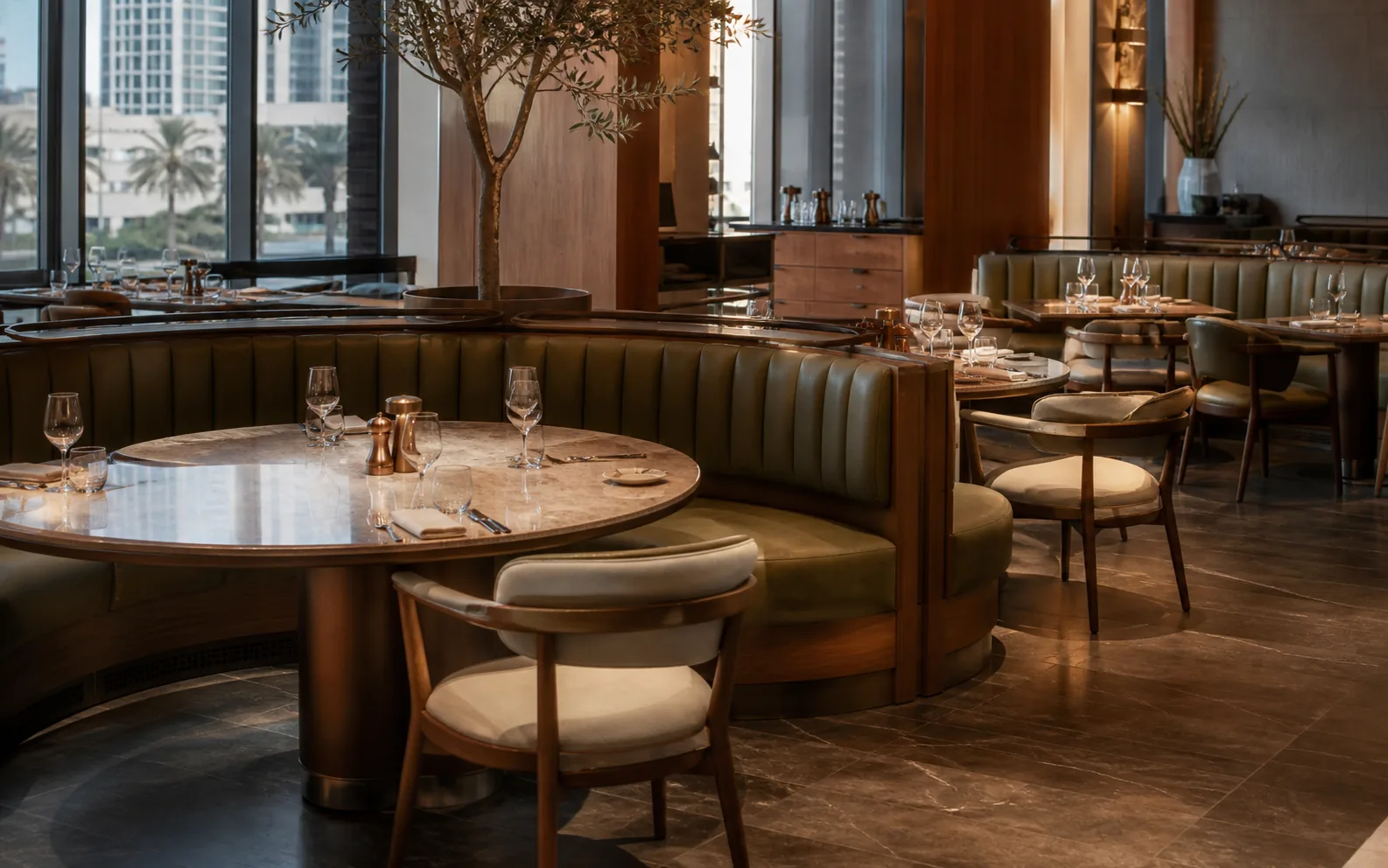
| Restaurants | Dining chairs, tables, banquettes, booths, buffet stations, bar stools | Wrong chair/table proportion, weak upholstery, unstable tables |
| Outdoor | Loungers, cabanas, daybeds, umbrellas, outdoor dining, poolside tables | Indoor-grade materials used outside |
| Spa | Treatment-room cabinets, relaxation loungers, lockers, vanities, reception furniture | Moisture and oil damage from wrong finishes |
| Back of house | Office desks, meeting tables, storage, staff seating | Procured too late because it is less visible |
BSA’s hospitality section breaks this into dedicated pages for guest rooms, suites and branded residences, lobbies and lounges, restaurants and bars, resort and pool areas, and spa and wellness.
Guest room furniture: where the money and risk sit
Guest rooms drive the largest repeated quantity. A small mistake becomes expensive because it repeats across every key. Before asking for a price, the owner or designer should confirm the room matrix:
- Standard king rooms
- Twin rooms
- Accessible rooms
- Connecting rooms
- Suites
- Serviced apartment units
- Operator-specific prototype rooms
The furniture schedule should identify every repeated item: bed base, mattress, headboard, nightstands, writing desk, desk chair, wardrobe, minibar cabinet, luggage bench, TV wall panel, mirror, lighting, curtain system, and loose seating.
Guest room details that decide quality
Small specification details matter more than broad descriptions:
- Headboards: wall-mounted or bed-mounted, padded or timber, integrated reading light or separate lamp, fabric or leather alternative, cleanable kick zone behind bed.
- Nightstands: drawer count, cable access, stone or timber top, hidden charging, open shelf versus closed storage.
- Desks: worktop durability, cable grommet position, chair clearance, minibar or drawer integration.
- Wardrobes: hanging depth, luggage storage, safe position, ventilation, door hardware, internal lighting.
- Luggage benches: frame strength, upholstery protection, wall clearance, housekeeping movement.
A hotel room mock-up should test these details with the operator, designer, housekeeping team, and supplier before mass production starts.
Public areas need a different mindset
Lobby and public-area furniture is less repetitive but more visible. It has to be beautiful, durable, and operational. A lobby is not a showroom. It is a moving environment with suitcases, queues, conversations, waiting families, concierge traffic, and coffee service.
For a Dubai hotel lobby, the furniture package should solve:
- Clear sightline from entrance to reception
- Seating clusters for different guest behaviors
- Luggage-friendly circulation
- Durable coffee and side table tops
- Upholstery that can be cleaned without visible damage
- Replaceable seat cushions
- Planters or screens that divide zones without blocking staff control
- Reception counter storage and cable management
Custom reception counters, concierge desks, and feature sofas should be engineered with the same seriousness as guest room furniture. They carry the property’s first impression.
Restaurant and bar furniture has to earn revenue
Restaurant furniture is an operational tool. Chairs, tables, bar stools, and banquettes influence covers, table turnover, staff movement, comfort, acoustics, and photography. In Dubai hotel F&B, the supplier should coordinate with the interior designer and operator before production.
Key checks:
- Dining chair seat height works with table height.
- Banquette seat depth and table offset are tested.
- Table bases do not block feet under banquettes.
- Bar stool height matches counter height.
- Upholstery is contract-grade and cleanable.
- Outdoor F&B furniture is specified for sun and humidity.
- Buffet and service furniture support actual service flow.
For related detail, see the restaurant furniture guide and restaurant banquette seating guide.
Materials that work in GCC hospitality
Material choice should be driven by use, not only mood board appearance.
| Material decision | Professional recommendation |
|---|---|
| Casegoods substrate | Use stable engineered boards with suitable veneer or laminate, not unstable solid timber for large panels |
| Guest room tops | Consider stone, compact laminate, treated veneer, or durable lacquer depending on use |
| Public upholstery | Use high-abrasion contract fabric, performance weave, faux leather, or leather alternative by zone |
| Outdoor frames | Powder-coated aluminium, treated teak, stainless hardware, outdoor rope, or weatherproof systems |
| Metal hardware | Corrosion-resistant screws, bolts, hinges, glides, and brackets |
| Curtains and upholstery | Confirm flame-retardant treatment and test certificates where required |
BSA’s project references include contract fabrics such as faux leather, polyurethane, velvets, and woven fabrics, with requirements such as stain and soil repellent finish, flame-proofing, corrosion-proof hardware, and sample approval before production. These details are not decorative. They protect the owner at handover and during operation.
Fire ratings and documentation
Fire-rating documentation must be requested before production, not at the end. For hospitality projects in the UAE and GCC, the relevant documentation may include upholstery, foam, curtains, decorative fabrics, artificial greenery, and selected wall or decorative elements.
A professional supplier should be able to provide:
- Fabric and foam certificates where required
- Curtain and drapery certificates where required
- Test standard references such as BS 5852, BS 7176, NFPA 260, NFPA 701, or project-specific standards
- Manufacturer certificates that match the exact fabric and construction
- A document register before final handover
Incomplete certificates can delay operator sign-off and authority approvals. For more detail, see UAE Civil Defence fire ratings for hotel furniture.
What to send before requesting a quotation
The quality of the RFQ controls the quality of the quotation. A professional hotel furniture RFQ should include:
- Room matrix by type and key count.
- Furniture schedule with item codes and quantities.
- Drawings for custom items.
- Reference images and design intent.
- Finish schedule for timber, metal, stone, fabric, and hardware.
- Fire-rating and operator requirements.
- Delivery address and freight terms.
- Installation scope and site constraints.
- Required sample and prototype process.
- Target opening date and required delivery phases.
If these are not ready, ask the supplier for a budget estimate rather than a final quotation. Treat early pricing as a range until drawings and finishes are locked.
How to compare suppliers properly
Do not compare hotel furniture suppliers only by total price. Compare the assumptions.
| Question | Why it matters |
|---|---|
| Are dimensions and finishes specified item by item? | Prevents cheaper quotes from hiding lower specifications |
| Is packing included? | Poor packing damages furniture before it reaches site |
| Are freight and customs included? | FOB, CIF, and DDP prices are not comparable |
| Is installation included? | Site installation is a major risk point |
| Are samples included? | Samples are where problems are found early |
| Are replacement parts possible? | Hotels need continuity after opening |
| Who owns snagging responsibility? | Avoids disputes between supplier, freight forwarder, and contractor |
The lowest quote is often not the lowest project cost. If a cheaper supplier causes rework, air freight, opening delay, or replacement within the first operating year, the saving disappears.
BSA’s role as a hotel furniture supplier
BSA Trading supplies hotel furniture and FF&E from Dubai for UAE and GCC projects. The scope can include guest room furniture, suite furniture, lobby furniture, reception counters, restaurant furniture, bar furniture, outdoor resort furniture, spa furniture, lighting, textiles, curtains, casegoods, and decorative elements.
We work with design intent, drawings, or mood boards, then coordinate production, samples, QC, packing, logistics, delivery, and installation support. The goal is not just to supply attractive furniture. The goal is to produce a complete, buildable, durable hotel furniture package that reaches the site on time and performs after opening.