Restaurant Banquette Seating in Dubai: Booths & Wall Seating
A professional guide to custom restaurant banquette seating in Dubai, covering booth layouts, wall seating, seat height, depth, back angle, upholstery, table offsets, frames, cleaning, shop drawings, and installation coordination.
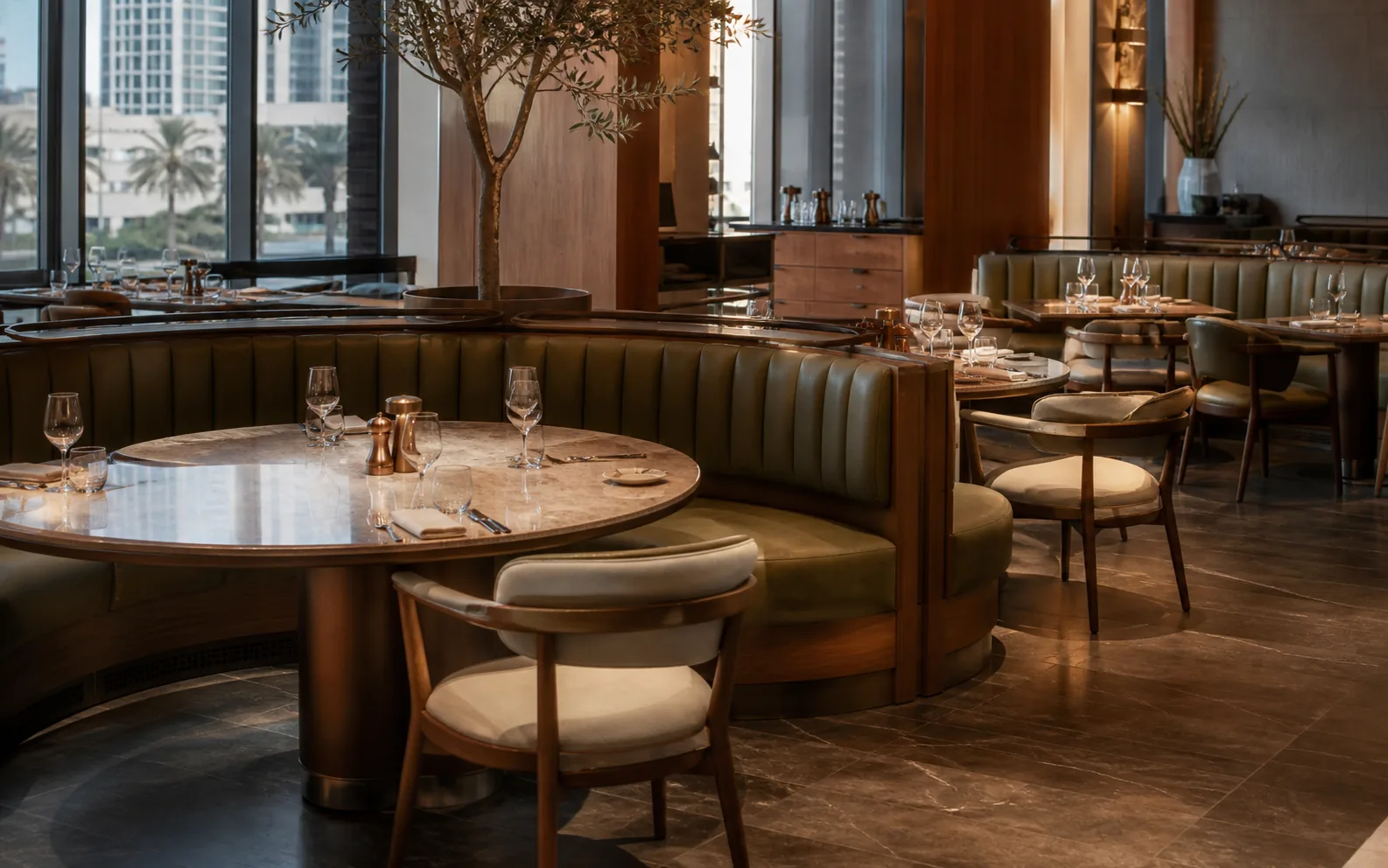
Banquette seating is one of the most valuable furniture tools in restaurant design. It can increase covers, create privacy, define the room, improve acoustics, and make the interior feel more expensive. It can also become uncomfortable, hard to clean, and costly to repair if the dimensions and construction are wrong.
Unlike loose chairs, banquettes are tied to the site. They meet walls, columns, floors, tables, lighting, and service routes. That means they need proper drawings, accurate measurements, and installation planning.
Professional rule: banquettes should be designed with the dining table, not after it. Comfort comes from the relationship between seat height, seat depth, table height, and table offset.
Where banquettes work best
Banquettes are useful in:
- Hotel restaurants
- All-day dining venues
- Cafes
- Fine dining rooms
- Bars and lounges
- Private dining rooms
- Mall restaurants
- Beach clubs
- Food halls
They work especially well along walls, around columns, in corners, and in areas where loose chairs would waste space.
Main banquette types
| Type | Best use | Risk |
|---|---|---|
| Straight wall banquette | Efficient wall seating | Can feel flat without detail |
| L-shaped banquette | Corners and private groups | Corner comfort and table access |
| U-shaped booth | Privacy and premium seating | Entry/exit can feel tight |
| Double-sided banquette | Central room divider | Back height and stability |
| Curved banquette | Feature seating | Requires precise fabrication |
| High-back banquette | Acoustic and privacy zoning | Can block sightlines if overused |
The right type depends on floor plan, service style, and desired guest behavior.
Dimensions that decide comfort
Banquette comfort is technical, and the working numbers are well established. These are the ranges we build to unless the design brief argues otherwise:
| Dimension | Working range | Why it matters |
|---|---|---|
| Seat height (compressed) | 45–48 cm | Measured after cushion compression, not on the drawing |
| Seat depth | 40–45 cm dining; up to 50 cm lounge | Deeper than 45 cm and diners slump away from the table |
| Back height from seat | 30–45 cm standard; 90+ cm high-back | High backs add privacy and acoustics, cost sightlines |
| Back angle | 5–10° for dining | More recline suits lounges, not meals |
| Table height | 74–76 cm | Standard dining; confirm against seat height as a pair |
| Table edge to seat edge | 25–30 cm | The single most-missed dimension in banquette failures |
| Base recess (toe kick) | 7–10 cm deep × 10 cm high | Without it guests sit sideways-on |
| Space per cover | 55–60 cm of run | Formal dining; casual venues squeeze to 50 cm |
A banquette that gets every number right but one still fails: if the seat is too deep, guests slump; if the table offset is too wide, dining is uncomfortable; if the base has no recess, feet have nowhere to go; if the back is too upright, a two-hour dinner feels like a flight.
The capacity argument for banquettes is also numeric, but it should be tested on the actual plan rather than reduced to a universal percentage. Wall seating removes the chair-back circulation zone on one side of a table. On a 7.2 m clear run, allowing 60 cm per cover creates 12 banquette positions; the loose-chair alternative must then be modelled with its actual table modules, chair pull-back zones, columns, and service route. That side-by-side plan is the reliable way to quantify the gain before fabrication.
One planning point that gets missed until authority review is accessible dining. Dubai’s official universal-design guide calls for 10% of dining tables to meet its accessible table dimensions, an accessible path at least 900 mm wide to half of the dining area, and 900 mm clear passage to food-service areas. Keep movable chairs at accessible table positions and coordinate the final count, routes, and clearances with the project consultant and approving authority before the banquettes enter production.
The project team should review a mock-up module or detailed sections before production. On fixed seating, a wrong dimension is not a return — it is a rebuild.
Table coordination
The table base is critical. Four-leg tables can clash with fixed seating. Pedestal bases can improve access but must be stable. Large stone tops may look premium but can be too heavy or unstable if the base is wrong.
Check:
- Can guests slide in and out easily?
- Does the table align with the banquette modules?
- Is there enough space for service?
- Does the base block feet?
- Can tables be separated for cleaning or events?
BSA can coordinate banquettes with restaurant tables and dining chairs so proportions and finishes work together.
Upholstery and cleaning
Banquette upholstery faces food, drink, body contact, cleaning chemicals, and constant friction — the hardest duty in hospitality seating. Specify contract fabric at 70,000–100,000+ Martindale rubs (tested to BS EN ISO 12947-2) for banquette duty, with a cleanability code that matches the venue’s actual cleaning regime; the full specification logic is in our contract fabrics guide. Suitable options include:
- Contract performance fabric (bleach-cleanable grades for high-turnover venues).
- Faux leather and coated performance materials — the practical default for all-day dining.
- Commercial velvet in lower-spill environments.
- Outdoor fabric for terraces or high-cleaning zones.
In Dubai and licensed UAE venues, the upholstery must also follow the fire-test route specified for the project. Dubai Civil Defence’s published code accepts several upholstered-furniture standards, including BS 7176, BS 5852, EN 1021-1/-2, and ASTM E1537; Crib 5 is therefore not a universal default. Where the selected test evaluates the complete upholstery build-up, the evidence must match the production fabric, interliner, and foam rather than a fabric sample alone. Confirm the required route with the consultant and approving authority before ordering; see UAE Civil Defence fire ratings for hotel furniture.
The upholstery detail matters as much as the fabric. Deep channels and decorative seams look rich but trap dirt; smooth panels clean faster. Removable seat cushions make repair and re-covering far cheaper over the venue’s life, but need secure construction so they stay put in daily service. And order 5–10% attic stock of the fabric in the same dye batch — a banquette re-cover from a later batch never quite matches.
Frame and base construction
Banquettes should have strong internal frames and serviceable construction. Ask:
- Is the banquette fixed or modular?
- Can modules be removed later?
- Is the base recessed?
- Is the base protected from mopping and shoes?
- Can cushions be replaced?
- Is the back finished if visible?
- How is the unit fixed to the wall or floor?
- Can it pass through site access routes?
For long banquettes, modular construction usually makes delivery and future repair easier.
Site measurement and installation
Final measurement should happen after relevant wall and floor finishes are complete or confirmed. Early measurements can be wrong if wall cladding, skirting, or flooring thickness changes.
Before installation, confirm:
- Finished wall length.
- Column positions.
- Skirting details.
- Floor level.
- Socket or service positions.
- Wall panels.
- Delivery access.
- Fixing method.
- Protection of finished surfaces.
BSA banquette seating supply
BSA Trading produces custom banquette seating, booths, upholstered benches, wall seating, bar seating, and matching restaurant furniture for Dubai and GCC projects. We can work from interior design drawings, site measurements, or a concept brief, then coordinate shop drawings, materials, upholstery, production, delivery, and installation support.
Request a banquette seating quote
Coordinate fixed seating with the wider restaurant table mix so the room serves the expected party sizes. For a smaller coffee venue, use our café seating and materials guide.