
Glass & Mirror · Material specification
Laminated Safety Glass Material Specifications
Laminated Safety Glass for furniture tops, doors, screens and decorative hospitality details, specified by safety treatment, thickness, edgework and support.
Current material reference
Two or more glass plies bonded with a clear or specified interlayer; 8–12 mm furniture thickness typical
Material guidance · supplier data required for approval
Material decision summary
Project suitability at a glance.
Select safety construction, thickness, edgework, support, tint and visual quality for the exact span and occupancy.
Best for
- +Screens, doors and furniture panels requiring fragment retention or post-breakage integrity
Avoid when
- −Interlayer, edge exposure, holes, fixings or post-breakage load have not been engineered
- Traffic level
- High
- Maintenance
- Medium
- Visual variation
- Low
- Relative budget
- ●●●○
- Suitable environments
- Interior · High traffic · Wet area
Material overview
Common material applications
Confirm safety construction, thickness, edgework, support, tint and visual quality. The correct specification depends on span, furniture type, occupancy and whether breakage could cause injury.
Material-specific authority schedule
Ten controls owned by this exact material—not inherited category rows. Final values are confirmed from supplier data, the project sample and shop drawings.
- Declared project reference
- Laminated Safety Glass: Two or more glass plies bonded with a clear or specified interlayer; 8–12 mm furniture thickness typical
- Exact material identity
- Laminated safety-glass make-up with glass ply type/thickness, interlayer chemistry/thickness, safety standard, edgework and support declared.
- Technical system definition
- Two or more glass plies permanently bonded by a declared interlayer to retain fragments and provide the scheduled post-breakage behaviour. Ply heat treatment, interlayer, edges, holes and support are engineered together.
- Selection differentiator
- The bonded interlayer retains fragments and can provide post-breakage integrity beyond monolithic tempered glass.
- Critical approval decision
- Define the required post-breakage function and select the complete make-up; applied safety film or monolithic tempering is not a laminated equivalent.
- Non-equivalent substitute
- Safety film applied to monolithic glass or tempered glass without lamination is not equivalent in retained fragments or residual capacity.
- Fabrication focus
- Finish holes and edges before heat treatment/lamination, protect interlayer edges and engineer every clamp, gasket and bearing point.
- GCC exposure limit
- Heat, UV and wet exposed edges can drive interlayer bubbles, haze or delamination; compatibility must match the location.
- Material-specific care rule
- Keep laminated edges dry, use compatible cleaner on faces and inspect clamps/edge chips after impact.
- Reject the delivery when
- Reject bubbles, haze, edge delamination, interlayer contamination, misaligned plies, chips, wrong make-up or unsupported post-breakage claim.
Approval pack
Documents required before ordering.
Material guidance · supplier data required for approval
- Laminated Safety Glass: Identity/source evidence: Laminated safety-glass make-up with glass ply type/thickness, interlayer chemistry/thickness, safety standard, edgework and support declared.
- Laminated Safety Glass: Signed selection evidence: Processor declaration and test evidence identify the exact proposed make-up.
- Laminated Safety Glass: Second technical gate: Full-size edge/fixing mock-up and engineering prove no hard contact or wet trapped edge.
- Laminated Safety Glass: Factory close-out: Finish holes and edges before heat treatment/lamination, protect interlayer edges and engineer every clamp, gasket and bearing point.
Lead time & availability
Confirmed after source, finish and quantity selection
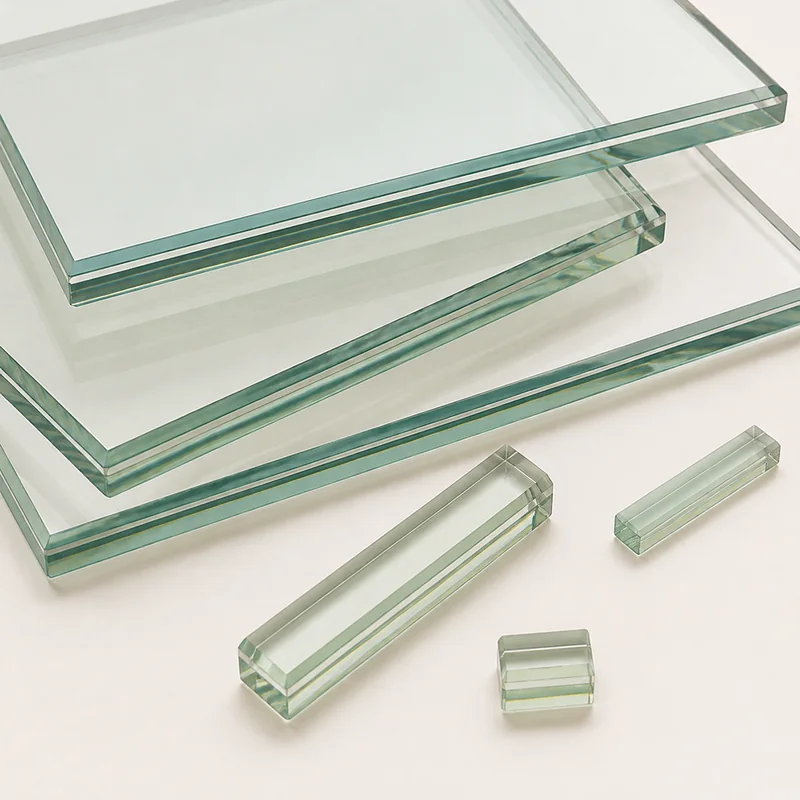
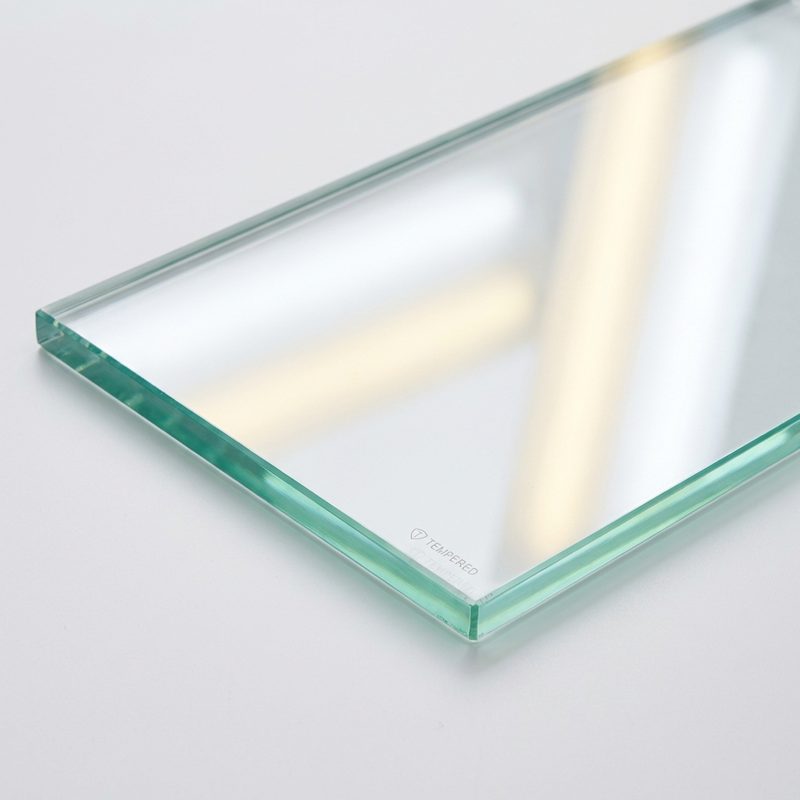
Material specimen views
One physical material sample, shown in four detail views.
Every crop comes from this material specimen itself, with no furniture product shown. The approved sample and current supplier documents govern final colour and construction.
Material identity
What is unique—and what is shared with the family.
The exact material fingerprint comes first. Shared family science is explicitly separated in a collapsible appendix instead of being presented as unique content.
50 material-specific points · 39 shared family references
01 · Material fingerprint
What makes this exact selection technically distinct?
Position in the material family
Laminated safety glass
- Reference that must be declared
- Laminated safety-glass make-up with glass ply type/thickness, interlayer chemistry/thickness, safety standard, edgework and support declared.
- Selection differentiator
- The bonded interlayer retains fragments and can provide post-breakage integrity beyond monolithic tempered glass.
- Not an equivalent substitute
- Safety film applied to monolithic glass or tempered glass without lamination is not equivalent in retained fragments or residual capacity.
- Reject the delivery when
- Reject bubbles, haze, edge delamination, interlayer contamination, misaligned plies, chips, wrong make-up or unsupported post-breakage claim.
Shared family reference
Open the shared Glass & Mirror engineering appendix
This appendix applies to the complete Glass & Mirror family. It is retained as supporting reference and is not counted as unique content for this material.
Shared family reference
Open the shared Glass & Mirror engineering appendix
This appendix applies to the complete Glass & Mirror family. It is retained as supporting reference and is not counted as unique content for this material.
02 · System anatomy
The material is not a single surface.
Two or more glass plies permanently bonded by a declared interlayer to retain fragments and provide the scheduled post-breakage behaviour. Ply heat treatment, interlayer, edges, holes and support are engineered together.
01Exposed face
Layer function
Float, tinted, patterned, coated or mirrored face determines appearance, scratch and cleaning behaviour.
How to verify
Declare face orientation, coating/backing position and visual-quality limits.
02Glass body
Layer function
Thickness, composition and heat treatment govern weight, strength, distortion and break pattern.
How to verify
Engineer final thickness and obtain safety-treatment declaration.
03Interlayer / safety backing
Layer function
Lamination or film can retain fragments and also change tint, edge appearance and moisture sensitivity.
How to verify
Specify interlayer/film type, colour, edge exposure and tested build.
04Edge / fixing interface
Layer function
Polished edges, holes, notches, pads, clamps and adhesive transfer load and concentrate stress.
How to verify
Complete all machining before tempering and coordinate support tolerances.
03 · Decision gates
Reference benchmarks and the project rule.
Safety construction
01- Reference band
- Annealed, heat-strengthened, tempered or laminated selected by location, support and post-breakage risk.
- Project rule
- Tempered strength and laminated fragment retention solve different problems.
- Evidence status
- Safety declaration and applicable test evidence
Thickness / span
02- Reference band
- BSA furniture reference often 8–12 mm; engineering governs final thickness for span, load, holes and support.
- Project rule
- Never approve thickness from appearance or precedent alone.
- Evidence status
- Calculation/shop drawing and glass make-up
Edge quality
03- Reference band
- Flat polish, arris, pencil, bevel or mitre with chip, shell, polish and corner-radius limits.
- Project rule
- High-contact furniture edges require a physical control and safe geometry.
- Evidence status
- Full-size edge/corner sample
Visual quality
04- Reference band
- Tint, distortion, roller wave, anisotropy, inclusions, seeds, scratches and coating uniformity.
- Project rule
- Set viewing distance, angle, lighting and background before inspection.
- Evidence status
- Boundary samples and first-off inspection
Machining
05- Reference band
- Every hole, notch, cut-out and edge must be final before tempering.
- Project rule
- Coordinate hardware tolerances and avoid field modification of tempered glass.
- Evidence status
- Approved fabrication drawing
Support / compatibility
06- Reference band
- Pad hardness, clamp pressure, adhesive chemistry, frame flatness and thermal movement are system decisions.
- Project rule
- Test adhesives against coatings, mirrors and interlayer edges.
- Evidence status
- Compatibility statement and assembled mock-up
04 · Family comparison
Four visually related systems that are not technically equivalent.


Monolithic tempered
- Best use
- Supported tops and panels requiring increased strength and safer break pattern.
- Trade-off / constraint
- Fragments are not retained; roller wave and spontaneous-breakage strategy need review.
Laminated safety glass
- Best use
- Applications requiring fragment retention, decorative interlayer or post-breakage integrity.
- Trade-off / constraint
- Edge moisture, interlayer compatibility, bubbles and tint affect quality.
Tinted / patterned glass
- Best use
- Privacy, texture and colour in doors, screens, furniture and lighting.
- Trade-off / constraint
- Texture direction, distortion and safety-treatment capability vary by product.
Mirror / antiqued mirror
- Best use
- Reflective casegoods and feature panels with deliberate clear or aged backing.
- Trade-off / constraint
- Backing, edge seal, safety film and adhesive chemistry govern durability.
05 · Factory handbook
Hold points from receiving through production release.
Fabrication focus for this exact material
Finish holes and edges before heat treatment/lamination, protect interlayer edges and engineer every clamp, gasket and bearing point.
-
01Glass make-up release
Control instruction
Freeze type, thickness, heat treatment, laminate/interlayer, coating face, tint and safety route.
Close-out evidence
Approved glass schedule and supplier declaration
-
02Template / machining
Control instruction
Coordinate final dimensions, holes, notches, radii, edgework and hardware tolerances before heat treatment.
Close-out evidence
Signed fabrication drawing/template
-
03Processing
Control instruction
Control cutting, grinding, washing, tempering or lamination without introducing chips, contamination or distortion.
Close-out evidence
Processor QC record and identification marking
-
04Visual inspection
Control instruction
Inspect under agreed light, angle and background for distortion, scratches, inclusions, pattern and tint.
Close-out evidence
Boundary samples and accepted first panel
-
05Assembly / installation
Control instruction
Use clean compatible pads, clamps, sealants and adhesive; verify support flatness and isolation.
Close-out evidence
Installed first-off with edge/fixing inspection
06 · Climate & operations
GCC exposure matrix and maintenance plan.
Material-specific climate warning
Heat, UV and wet exposed edges can drive interlayer bubbles, haze or delamination; compatibility must match the location.
01Guestroom / casegood
Preferred- Material response
- Generally suitable with safe edgework, controlled support and housekeeping instructions.
- Design control
- Choose safety route by size, location and breakage consequence.
02High-traffic public area
Conditional- Material response
- Impact, trolley collision and high-contact edges increase injury and breakage consequence.
- Design control
- Use engineered safety construction and protected/visible edges.
03Tabletop / F&B
Conditional- Material response
- Hot items, impacts, scratches and aggressive cleaning affect surface and edge.
- Design control
- Engineer support, use safe edge profile and issue cleaner/heat limits.
04Wet area
Conditional- Material response
- Water challenges mirror backing, laminate edges, adhesive and metal fixings.
- Design control
- Use compatible sealed edges, ventilation and corrosion-resistant hardware.
05Direct solar heat
Conditional- Material response
- Tint, coating and partial shading can increase thermal stress.
- Design control
- Complete thermal review where glazing receives uneven solar load.
06Exterior / balustrade-like use
Avoid- Material response
- Furniture guidance is insufficient for structural guarding or overhead applications.
- Design control
- Use project structural-glazing code, engineer and tested system.
Operational maintenance plan
Material-specific care rule
Keep laminated edges dry, use compatible cleaner on faces and inspect clamps/edge chips after impact.
-
01Daily / weekly
Action
Remove grit first, then clean with soft non-abrasive tools and approved glass solution.
Prohibited
No razor, abrasive pad or dirty squeegee on decorative/coated faces.
-
02After a spill
Action
Clean and dry edges, holes, hardware interfaces and mirror joints promptly.
Prohibited
No pooling at laminate or mirror edges.
-
03Monthly
Action
Inspect chips, scratches, loose clamps, pad migration, adhesive spots and backing attack.
Prohibited
Do not keep chipped load-bearing or high-contact glass in service without review.
-
04Periodic
Action
Check supports, hardware torque, sealant/adhesive condition and furniture level.
Prohibited
No field drilling, grinding or edge alteration of tempered glass.
-
05Replacement
Action
Order from the recorded make-up, processor, tint, pattern direction and fabrication drawing.
Prohibited
Do not substitute annealed glass or a visually similar unsupported product.
07 · Reference library
The language that governs the decision—and where it comes from.
Material glossary
- 01Tempered
- Heat-treated glass with increased strength and a small-fragment break pattern.
- 02Laminated
- Two or more glass layers bonded with an interlayer that can retain fragments.
- 03Roller wave
- Optical distortion introduced during horizontal tempering.
- 04Anisotropy
- Visible strain pattern in heat-treated glass under certain light/polarisation conditions.
- 05Arris
- A small removal of the sharp edge; it is not the same as a fully polished edge.
Professional and standards sources
- 01
National Glass Association
Glass use in furniture
Furniture glass types, breakage considerations and safety construction.
Open primary source ↗ - 02
National Glass Association
Laminated glass use in furniture
Fragment retention, tempered/laminated options and furniture safety context.
Open primary source ↗ - 03
BSI
BS EN 12150-1 toughened safety glass
Definition and description of thermally toughened soda-lime silicate safety glass.
Open primary source ↗ - 04
National Glass Association
Technical resource library
Fabrication, laminating, decorative glass, cleaning and compatibility papers.
Open primary source ↗
Material-specific technical dossier
Laminated Safety Glass controls from decision to production.
Every row below is tied to this material’s identity, differentiator, fabrication, exposure or care route; no generic family rows are included in this dossier.
8 unique controls · 4 contextual test applications · 5 material-specific risks
System definition
Two or more glass plies permanently bonded by a declared interlayer to retain fragments and provide the scheduled post-breakage behaviour. Ply heat treatment, interlayer, edges, holes and support are engineered together.
Critical decision
Define the required post-breakage function and select the complete make-up; applied safety film or monolithic tempering is not a laminated equivalent.
01 · Selection variables
What the material schedule must lock.
01Laminated Safety Glass: Laminated make-up
- What must be declared
- Ply glass type/thickness/heat treatment, interlayer chemistry/thickness/colour, overall thickness and safety classification
- Approval basis
- Processor declaration and test evidence identify the exact proposed make-up.
02Laminated Safety Glass: Edges, holes and support
- What must be declared
- Edge polish/seal, interlayer exposure, hole/notch radii, clamps, gaskets, bearing, residual load and drainage
- Approval basis
- Full-size edge/fixing mock-up and engineering prove no hard contact or wet trapped edge.
03Laminated Safety Glass: identity declaration
- What must be declared
- Laminated safety-glass make-up with glass ply type/thickness, interlayer chemistry/thickness, safety standard, edgework and support declared.
- Approval basis
- Define the required post-breakage function and select the complete make-up; applied safety film or monolithic tempering is not a laminated equivalent.
04Laminated Safety Glass: equivalency boundary
- What must be declared
- The bonded interlayer retains fragments and can provide post-breakage integrity beyond monolithic tempered glass.
- Approval basis
- Safety film applied to monolithic glass or tempered glass without lamination is not equivalent in retained fragments or residual capacity.
05Laminated Safety Glass: factory execution
- What must be declared
- Finish holes and edges before heat treatment/lamination, protect interlayer edges and engineer every clamp, gasket and bearing point.
- Approval basis
- Processor declaration and test evidence identify the exact proposed make-up.
06Laminated Safety Glass: GCC exposure control
- What must be declared
- Heat, UV and wet exposed edges can drive interlayer bubbles, haze or delamination; compatibility must match the location.
- Approval basis
- Release only when the project detail and maintenance route close this exact exposure risk for Laminated Safety Glass.
07Laminated Safety Glass: operational care route
- What must be declared
- Keep laminated edges dry, use compatible cleaner on faces and inspect clamps/edge chips after impact.
- Approval basis
- Issue a named cleaning and repair method for Laminated Safety Glass; generic family care is not approval.
08Laminated Safety Glass: delivery rejection boundary
- What must be declared
- Reject bubbles, haze, edge delamination, interlayer contamination, misaligned plies, chips, wrong make-up or unsupported post-breakage claim.
- Approval basis
- The signed sample, first-off item and delivery inspection must all close this rejection condition for Laminated Safety Glass.
| Variable | What must be declared | Approval basis |
|---|---|---|
| 01Laminated Safety Glass: Laminated make-up | Ply glass type/thickness/heat treatment, interlayer chemistry/thickness/colour, overall thickness and safety classification | Processor declaration and test evidence identify the exact proposed make-up. |
| 02Laminated Safety Glass: Edges, holes and support | Edge polish/seal, interlayer exposure, hole/notch radii, clamps, gaskets, bearing, residual load and drainage | Full-size edge/fixing mock-up and engineering prove no hard contact or wet trapped edge. |
| 03Laminated Safety Glass: identity declaration | Laminated safety-glass make-up with glass ply type/thickness, interlayer chemistry/thickness, safety standard, edgework and support declared. | Define the required post-breakage function and select the complete make-up; applied safety film or monolithic tempering is not a laminated equivalent. |
| 04Laminated Safety Glass: equivalency boundary | The bonded interlayer retains fragments and can provide post-breakage integrity beyond monolithic tempered glass. | Safety film applied to monolithic glass or tempered glass without lamination is not equivalent in retained fragments or residual capacity. |
| 05Laminated Safety Glass: factory execution | Finish holes and edges before heat treatment/lamination, protect interlayer edges and engineer every clamp, gasket and bearing point. | Processor declaration and test evidence identify the exact proposed make-up. |
| 06Laminated Safety Glass: GCC exposure control | Heat, UV and wet exposed edges can drive interlayer bubbles, haze or delamination; compatibility must match the location. | Release only when the project detail and maintenance route close this exact exposure risk for Laminated Safety Glass. |
| 07Laminated Safety Glass: operational care route | Keep laminated edges dry, use compatible cleaner on faces and inspect clamps/edge chips after impact. | Issue a named cleaning and repair method for Laminated Safety Glass; generic family care is not approval. |
| 08Laminated Safety Glass: delivery rejection boundary | Reject bubbles, haze, edge delamination, interlayer contamination, misaligned plies, chips, wrong make-up or unsupported post-breakage claim. | The signed sample, first-off item and delivery inspection must all close this rejection condition for Laminated Safety Glass. |
02 · Verification
Test and evidence matrix.
Test methods are not compliance certificates or automatic pass values. The project must state the method, required result, tested construction and current report it will accept.
BS EN 12150-1:2015+A1:2019
01- What it measures
- Tolerances, flatness, edgework, fragmentation and characteristics of thermally toughened soda-lime safety glass.
- How to use it here
- Use for applicable monolithic toughened soda-lime glass; assemblies and post-toughening surface work need additional review. Material-specific acceptance for Laminated Safety Glass: Processor declaration and test evidence identify the exact proposed make-up.
Project laminated-glass standard
02- What it measures
- Interlayer, bond, safety-breakage retention and durability of laminated construction.
- How to use it here
- Specify make-up, interlayer, edge exposure and retention requirement for the exact application. Material-specific acceptance for Laminated Safety Glass: Full-size edge/fixing mock-up and engineering prove no hard contact or wet trapped edge.
Project visual-quality standard
03- What it measures
- Inspection of distortion, scratches, inclusions, tint and decorative uniformity.
- How to use it here
- Agree objective viewing conditions before production; do not inspect only under extreme raking light. Material-specific acceptance for Laminated Safety Glass: Select compatible interlayer/sealants, protect/drain edges and approve ageing evidence.
Engineering calculation / prototype
04- What it measures
- Verification of thickness, support, fixing and furniture load path.
- How to use it here
- Required where span, overhang, holes, point fixings or foreseeable impact are material. Material-specific acceptance for Laminated Safety Glass: Finish holes and edges before heat treatment/lamination, protect interlayer edges and engineer every clamp, gasket and bearing point.
03 · Performance
Failure-mode and control register.
01Laminated Safety Glass: Bubbles, haze or edge delamination develop
- Likely cause
- Moisture, heat, UV, incompatible sealant or poor laminating process attacks the interlayer bond.
- Preventive control
- Select compatible interlayer/sealants, protect/drain edges and approve ageing evidence.
02Laminated Safety Glass: non-equivalent substitution accepted
- Likely cause
- Safety film applied to monolithic glass or tempered glass without lamination is not equivalent in retained fragments or residual capacity.
- Preventive control
- Laminated safety-glass make-up with glass ply type/thickness, interlayer chemistry/thickness, safety standard, edgework and support declared.
03Laminated Safety Glass: material signature lost in fabrication
- Likely cause
- The workshop route does not implement the material-specific fabrication focus: Finish holes and edges before heat treatment/lamination, protect interlayer edges and engineer every clamp, gasket and bearing point.
- Preventive control
- Full-size edge/fixing mock-up and engineering prove no hard contact or wet trapped edge.
04Laminated Safety Glass: GCC exposure mismatch
- Likely cause
- Heat, UV and wet exposed edges can drive interlayer bubbles, haze or delamination; compatibility must match the location.
- Preventive control
- Re-detail, relocate or reject Laminated Safety Glass where the stated exposure cannot be controlled.
05Laminated Safety Glass: cleaning or maintenance damage
- Likely cause
- Keep laminated edges dry, use compatible cleaner on faces and inspect clamps/edge chips after impact.
- Preventive control
- Train operations on the named care route and retain a signed repair reference for Laminated Safety Glass.
| Failure mode | Likely cause | Preventive control |
|---|---|---|
| 01Laminated Safety Glass: Bubbles, haze or edge delamination develop | Moisture, heat, UV, incompatible sealant or poor laminating process attacks the interlayer bond. | Select compatible interlayer/sealants, protect/drain edges and approve ageing evidence. |
| 02Laminated Safety Glass: non-equivalent substitution accepted | Safety film applied to monolithic glass or tempered glass without lamination is not equivalent in retained fragments or residual capacity. | Laminated safety-glass make-up with glass ply type/thickness, interlayer chemistry/thickness, safety standard, edgework and support declared. |
| 03Laminated Safety Glass: material signature lost in fabrication | The workshop route does not implement the material-specific fabrication focus: Finish holes and edges before heat treatment/lamination, protect interlayer edges and engineer every clamp, gasket and bearing point. | Full-size edge/fixing mock-up and engineering prove no hard contact or wet trapped edge. |
| 04Laminated Safety Glass: GCC exposure mismatch | Heat, UV and wet exposed edges can drive interlayer bubbles, haze or delamination; compatibility must match the location. | Re-detail, relocate or reject Laminated Safety Glass where the stated exposure cannot be controlled. |
| 05Laminated Safety Glass: cleaning or maintenance damage | Keep laminated edges dry, use compatible cleaner on faces and inspect clamps/edge chips after impact. | Train operations on the named care route and retain a signed repair reference for Laminated Safety Glass. |
04 · Tender-ready
Copy-ready specification clause.
Provide laminated safety glass with each ply type, thickness and heat treatment; interlayer chemistry, thickness and colour; overall make-up; edgework and applicable safety standard declared. Submit evidence for the required impact and post-breakage performance plus interlayer compatibility with sealants, cleaners, UV, heat and edge exposure. Engineering shall show holes, notches, clamps, gaskets, support and residual load. Approve a full-size edge/fixing sample; applied film and monolithic tempered glass are not equivalent.
05 · Quality control
Inspection plan from submittal to handover.
01Laminated Safety Glass: identity and source
- Inspection
- Laminated safety-glass make-up with glass ply type/thickness, interlayer chemistry/thickness, safety standard, edgework and support declared.
- Acceptance / hold point
- Documents, labels and physical material all identify the same Laminated Safety Glass construction and source.
02Laminated Safety Glass: control sample
- Inspection
- The bonded interlayer retains fragments and can provide post-breakage integrity beyond monolithic tempered glass.
- Acceptance / hold point
- Processor declaration and test evidence identify the exact proposed make-up.
03Laminated Safety Glass: first-off fabrication
- Inspection
- Finish holes and edges before heat treatment/lamination, protect interlayer edges and engineer every clamp, gasket and bearing point.
- Acceptance / hold point
- Full-size edge/fixing mock-up and engineering prove no hard contact or wet trapped edge.
04Laminated Safety Glass: exposure and care trial
- Inspection
- Heat, UV and wet exposed edges can drive interlayer bubbles, haze or delamination; compatibility must match the location. Keep laminated edges dry, use compatible cleaner on faces and inspect clamps/edge chips after impact.
- Acceptance / hold point
- Select compatible interlayer/sealants, protect/drain edges and approve ageing evidence.
05Laminated Safety Glass: delivery release
- Inspection
- Reject bubbles, haze, edge delamination, interlayer contamination, misaligned plies, chips, wrong make-up or unsupported post-breakage claim.
- Acceptance / hold point
- Laminated Safety Glass is released only when no stated rejection condition is present and the signed reference remains traceable.
| Stage | Inspection | Acceptance / hold point |
|---|---|---|
| 01Laminated Safety Glass: identity and source | Laminated safety-glass make-up with glass ply type/thickness, interlayer chemistry/thickness, safety standard, edgework and support declared. | Documents, labels and physical material all identify the same Laminated Safety Glass construction and source. |
| 02Laminated Safety Glass: control sample | The bonded interlayer retains fragments and can provide post-breakage integrity beyond monolithic tempered glass. | Processor declaration and test evidence identify the exact proposed make-up. |
| 03Laminated Safety Glass: first-off fabrication | Finish holes and edges before heat treatment/lamination, protect interlayer edges and engineer every clamp, gasket and bearing point. | Full-size edge/fixing mock-up and engineering prove no hard contact or wet trapped edge. |
| 04Laminated Safety Glass: exposure and care trial | Heat, UV and wet exposed edges can drive interlayer bubbles, haze or delamination; compatibility must match the location. Keep laminated edges dry, use compatible cleaner on faces and inspect clamps/edge chips after impact. | Select compatible interlayer/sealants, protect/drain edges and approve ageing evidence. |
| 05Laminated Safety Glass: delivery release | Reject bubbles, haze, edge delamination, interlayer contamination, misaligned plies, chips, wrong make-up or unsupported post-breakage claim. | Laminated Safety Glass is released only when no stated rejection condition is present and the signed reference remains traceable. |
Required approval evidence
- +Laminated Safety Glass: Identity/source evidence: Laminated safety-glass make-up with glass ply type/thickness, interlayer chemistry/thickness, safety standard, edgework and support declared.
- +Laminated Safety Glass: Signed selection evidence: Processor declaration and test evidence identify the exact proposed make-up.
- +Laminated Safety Glass: Second technical gate: Full-size edge/fixing mock-up and engineering prove no hard contact or wet trapped edge.
- +Laminated Safety Glass: Factory close-out: Finish holes and edges before heat treatment/lamination, protect interlayer edges and engineer every clamp, gasket and bearing point.
- +Laminated Safety Glass: Exposure and care record: Heat, UV and wet exposed edges can drive interlayer bubbles, haze or delamination; compatibility must match the location. Keep laminated edges dry, use compatible cleaner on faces and inspect clamps/edge chips after impact.
- +Laminated Safety Glass: Delivery rejection record: Reject bubbles, haze, edge delamination, interlayer contamination, misaligned plies, chips, wrong make-up or unsupported post-breakage claim.
Questions to close before approval
- 01Laminated Safety Glass: Has the exact identity been declared and evidenced: Laminated safety-glass make-up with glass ply type/thickness, interlayer chemistry/thickness, safety standard, edgework and support declared?
- 02Laminated Safety Glass: Which project requirement makes this differentiator necessary: The bonded interlayer retains fragments and can provide post-breakage integrity beyond monolithic tempered glass?
- 03Laminated Safety Glass: Has the team excluded the non-equivalent route: Safety film applied to monolithic glass or tempered glass without lamination is not equivalent in retained fragments or residual capacity?
- 04Laminated Safety Glass: How will the factory prove this execution control: Finish holes and edges before heat treatment/lamination, protect interlayer edges and engineer every clamp, gasket and bearing point?
- 05Laminated Safety Glass: Can the project control this GCC exposure: Heat, UV and wet exposed edges can drive interlayer bubbles, haze or delamination; compatibility must match the location?
- 06Laminated Safety Glass: Who owns this operating rule after handover: Keep laminated edges dry, use compatible cleaner on faces and inspect clamps/edge chips after impact?
Material specimen detail
Laminated Safety Glass as a physical material sample.
This specimen view focuses on the surface, edge and construction of Laminated Safety Glass. No furniture product is presented here; the approved physical sample remains the reference for final colour, texture and finish.
Project notes
From sample to production.
01
What to specify
Confirm safety construction, thickness, edgework, support, tint and visual quality. The correct specification depends on span, furniture type, occupancy and whether breakage could cause injury.
02
Fabrication & detailing
All holes, notches and edgework are completed before tempering. Confirm support pads, fixing tolerances, thermal movement and safe handling clearances in the shop drawing.
03
Colour & finish approval
Glass tone changes with thickness, background and lighting. Samples should be viewed beside the intended stone, timber or metal and against the final interior light.
04
Care & maintenance
Use a soft lint-free cloth and non-abrasive glass cleaner. Keep liquids away from laminated edges and decorative backings; do not use blades on coated surfaces.
Specification note
This page is a preliminary material-specification guide. Current product data, test reports, the physical material sample and the intended application system must be approved for each project before ordering or manufacture.
Related materials