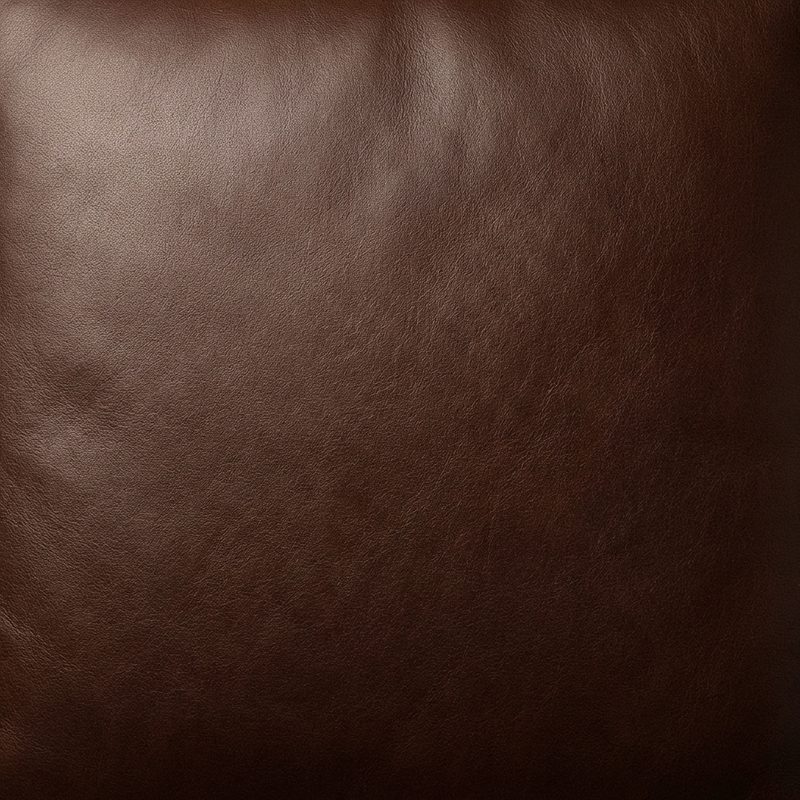
Leather · Furniture specification
Sand Nubuck Leather Furniture Specifications
A tactile, low-sheen leather for feature furniture and low-to-moderate traffic areas where touch and tonal depth lead the selection.
Current material reference
Buffed top grain with suede-like nap; protective treatment recommended
Material guidance · supplier data required for approval
Material decision summary
Project suitability at a glance.
Balance touch and natural character against stain protection, colour consistency and replacement practicality.
Best for
- +Feature seating, benches, headboards and tactile casegood details
- +Interiors where ageing and patina can be part of the design
Avoid when
- −Frequent spills, dark denim transfer or simple wipe-clean maintenance are expected
- Traffic level
- Low
- Maintenance
- High
- Visual variation
- High
- Relative budget
- ●●●●
- Suitable environments
- Interior
Material overview
Most requested furniture applications
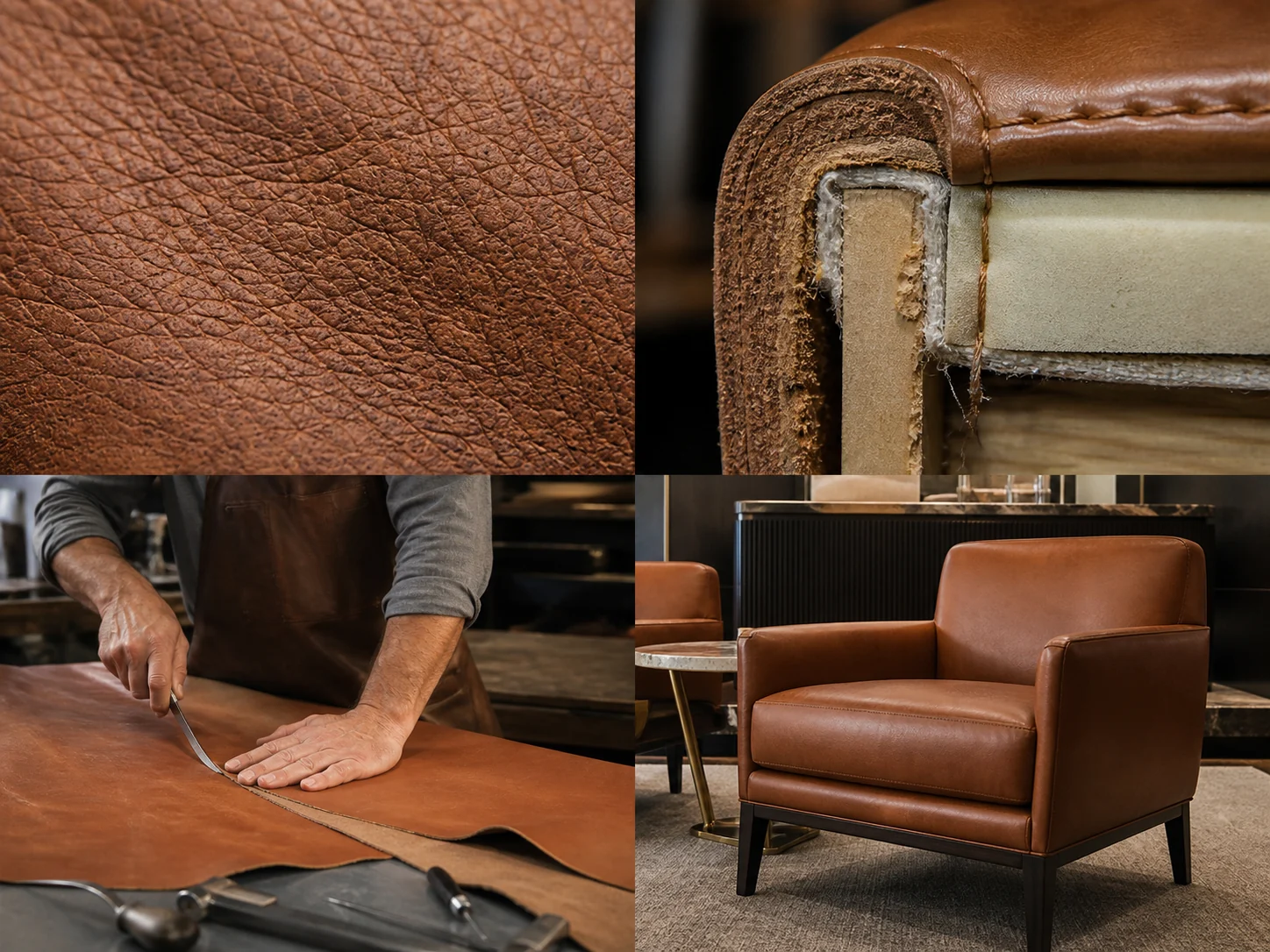
Choose by traffic, cleanability and desired patina. Aniline leather offers the richest character but less stain protection; protected or engineered leather is often preferred for high-turnover hospitality seating.
Material-specific authority schedule
Ten controls owned by this exact material—not inherited category rows. Final values are confirmed from supplier data, the project sample and shop drawings.
- Declared project reference
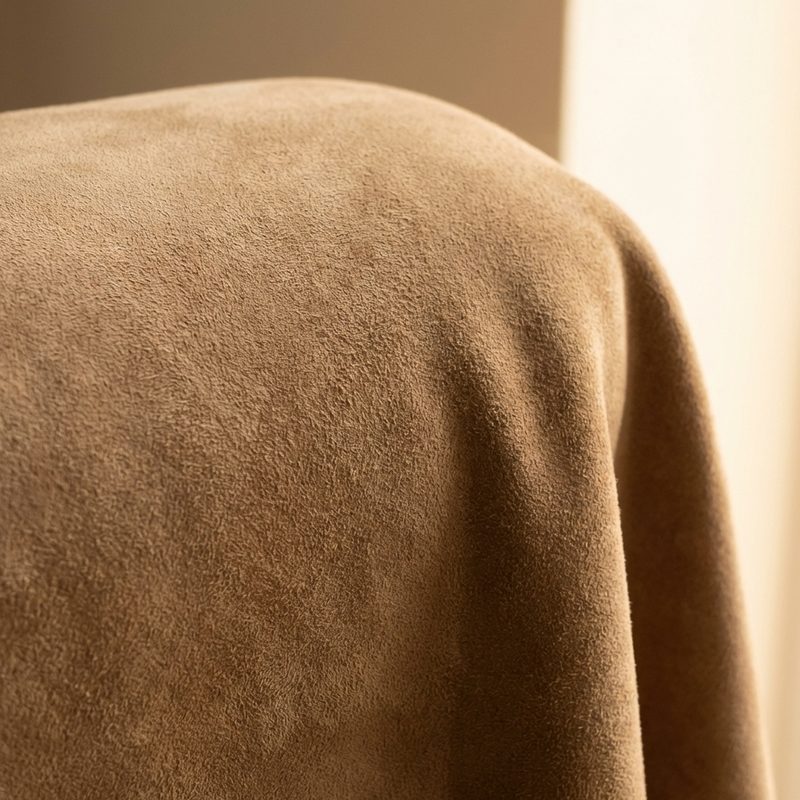
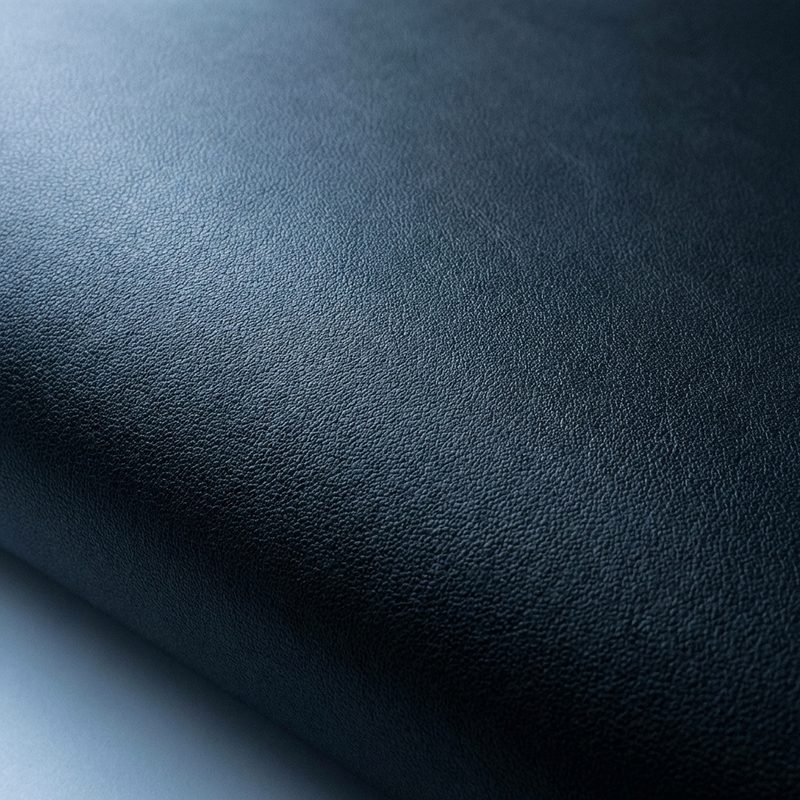
- Sand Nubuck Leather: Buffed top grain with suede-like nap; protective treatment recommended
- Exact material identity
- Sand-coloured nubuck top-grain leather with buffed nap; exact substance, stain protection and fastness must be declared.
- Technical system definition
- A top-grain hide buffed to a velvet-like nap. Its tactile sand surface is intentionally open and low-sheen, making liquid, oil, denim transfer and finger tracking especially visible.
- Selection differentiator
- Velvety nap and light tone create exceptional touch with intentionally sensitive surface behaviour.
- Critical approval decision
- Use only where touch is more important than wipe-clean uniformity, and agree the protection treatment without flattening or plasticising the nubuck nap.
- Non-equivalent substitute
- Microfibre suede or embossed coated fabric is not equivalent to buffed top-grain nubuck.
- Fabrication focus
- Align nap, avoid adhesive/handling contamination and map every high-visibility panel.
- GCC exposure limit
- Sand tone and open nap expose denim transfer, airborne dust and water marks quickly.
- Material-specific care rule
- Use nubuck brush/eraser and specialist dry methods; water and conditioner can permanently alter nap.
- Reject the delivery when
- Reject grease marks, water tide lines, polished nap, severe shade split or glue contamination.
Approval pack
Documents required before ordering.
Material guidance · supplier data required for approval
- Sand Nubuck Leather: Identity/source evidence: Sand-coloured nubuck top-grain leather with buffed nap; exact substance, stain protection and fastness must be declared.
- Sand Nubuck Leather: Signed selection evidence: Protected production sample retains approved dry touch and shade movement.
- Sand Nubuck Leather: Second technical gate: Demonstration defines permanent marking and realistic recovery.
- Sand Nubuck Leather: Factory close-out: Align nap, avoid adhesive/handling contamination and map every high-visibility panel.
Lead time & availability
Confirmed after source, finish and quantity selection
Family inspection atlas
A shared visual reference for construction and fabrication.
This atlas is shared by the material family; it is not a microscopy record of this exact selection. The approved sample and current supplier documents govern final colour and construction.
Material identity
What is unique—and what is shared with the family.
The exact material fingerprint comes first. Shared family science is explicitly separated in a collapsible appendix instead of being presented as unique content.
50 material-specific points · 40 shared family references
01 · Material fingerprint
What makes this exact selection technically distinct?
Position in the material family
Nubuck / buffed grain
- Reference that must be declared
- Sand-coloured nubuck top-grain leather with buffed nap; exact substance, stain protection and fastness must be declared.
- Selection differentiator
- Velvety nap and light tone create exceptional touch with intentionally sensitive surface behaviour.
- Not an equivalent substitute
- Microfibre suede or embossed coated fabric is not equivalent to buffed top-grain nubuck.
- Reject the delivery when
- Reject grease marks, water tide lines, polished nap, severe shade split or glue contamination.
Shared family reference
Open the shared Leather engineering appendix
This appendix applies to the complete Leather family. It is retained as supporting reference and is not counted as unique content for this material.
Shared family reference
Open the shared Leather engineering appendix
This appendix applies to the complete Leather family. It is retained as supporting reference and is not counted as unique content for this material.
02 · System anatomy
The material is not a single surface.
A top-grain hide buffed to a velvet-like nap. Its tactile sand surface is intentionally open and low-sheen, making liquid, oil, denim transfer and finger tracking especially visible.
01Finish film
Layer function
Dyes, pigments, binders and topcoat determine stain protection, touch and repair route.
How to verify
Declare aniline, semi-aniline, pigmented, nubuck or coated finish class.
02Grain layer
Layer function
Full grain, corrected grain, split or reconstituted face controls character and flex behaviour.
How to verify
Supplier declaration and cut edge must describe the same leather class.
03Fibre structure
Layer function
Collagen density changes from backbone to belly, affecting stretch, cutting and visible panel consistency.
How to verify
Approve full-hide map and cutting zones for adjacent visible panels.
04Upholstery interface
Layer function
Foam radius, seam, perforation, adhesive and tension determine creasing and finish stress.
How to verify
Prototype the tightest radius, perforation and highest-load seam.
03 · Decision gates
Reference benchmarks and the project rule.
Leather identity
01- Reference band
- Species, grain layer, tanning route, finish class and nominal substance/thickness.
- Project rule
- Do not approve “genuine leather” as a complete specification.
- Evidence status
- Supplier declaration and full-hide control
Dry / wet rub
02- Reference band
- ISO 11640 measures surface behaviour under repeated rubbing with wool felt.
- Project rule
- Set cycles and grey-scale acceptance by finish class and end use.
- Evidence status
- Exact colour and finish test report
Tear resistance
03- Reference band
- Method and target depend on leather class, thickness, seam and perforation.
- Project rule
- Require evidence for tight upholstery, thin panels and perforated details.
- Evidence status
- Current tear result plus seam prototype
Flex endurance
04- Reference band
- Critical at piping, folds, cushion fronts and frequently flexed upholstery.
- Project rule
- Test the proposed finish and thickness; inspect for cracking or delamination.
- Evidence status
- Flex report and aged folded sample
Colour / character range
05- Reference band
- Natural markings, scars, wrinkles, grain and shade require minimum/maximum controls.
- Project rule
- Approve at full-hide scale, not from a hand sample alone.
- Evidence status
- Mapped full hides and assembled first-off
Chemical care
06- Reference band
- Finish-specific; generic leather cleaner is not automatically compatible.
- Project rule
- Name cleaner, conditioner policy, dilution and prohibited chemicals.
- Evidence status
- Written care sheet and spot trial
04 · Family comparison
Visually related systems that are not technically equivalent.
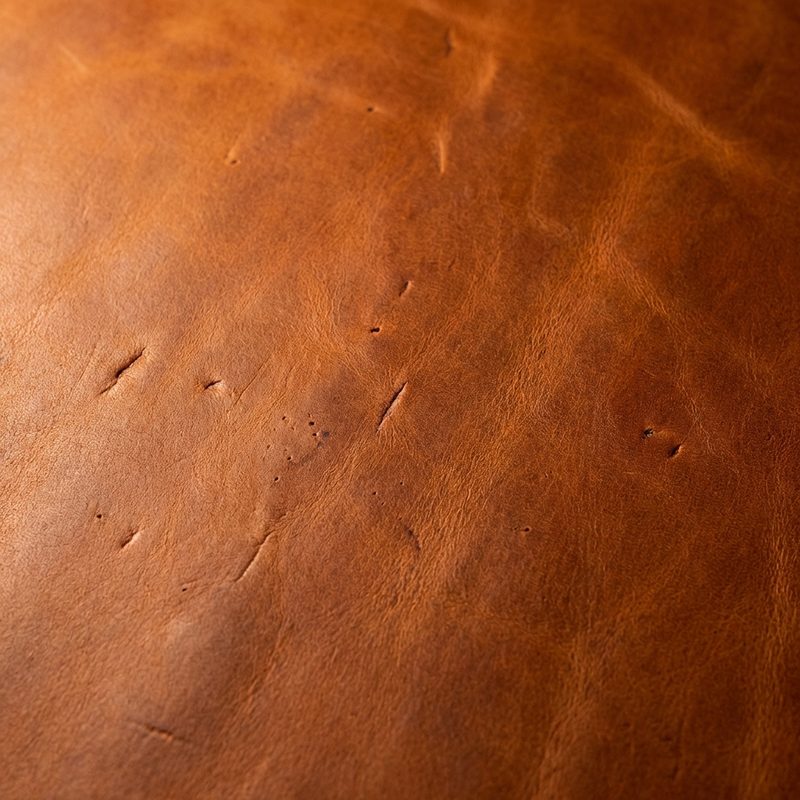
Full-grain / aniline
- Best use
- Premium feature furniture where natural grain and patina are design assets.
- Trade-off / constraint
- Highest natural variation and lowest tolerance for spills or aggressive cleaning.
Semi-aniline
- Best use
- Luxury hospitality seating balancing natural handle with light protection.
- Trade-off / constraint
- Still develops character and requires controlled chemicals and colour ranges.
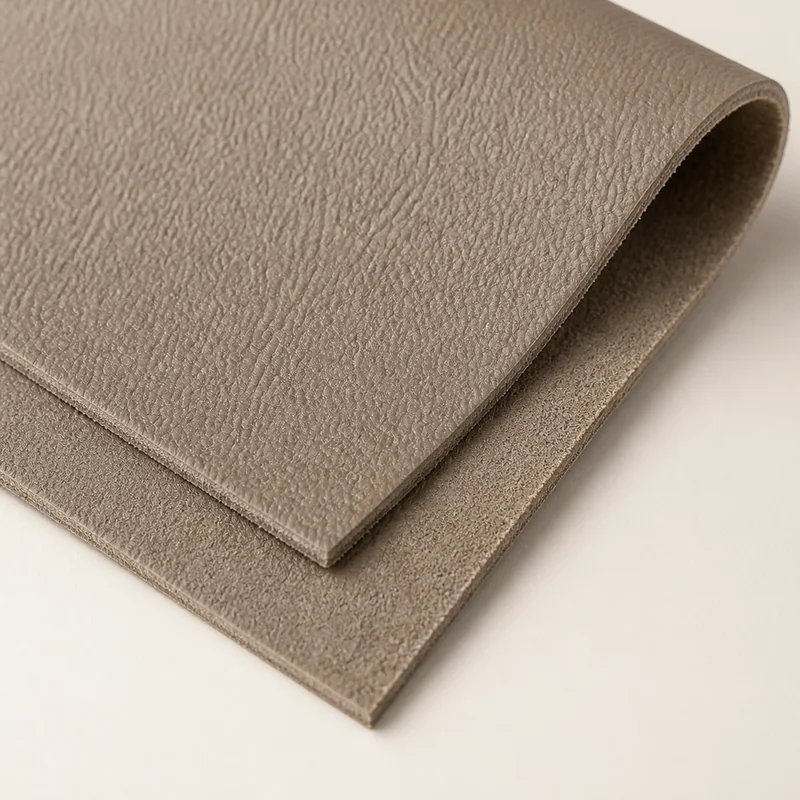
Nubuck / buffed grain
- Best use
- Low-traffic tactile accents where a velvety surface is the priority.
- Trade-off / constraint
- Water marking, denim transfer and difficult spot cleaning are major constraints.
Bonded / engineered leather
- Best use
- Cost-controlled, visually consistent indoor details and moderate-duty seating.
- Trade-off / constraint
- Ageing, flex life, repair and premium hide character differ from natural top-grain leather.
Protected pigmented leather
- Best use
- High-turnover natural-leather seating requiring consistent colour and practical cleaning.
- Trade-off / constraint
- A heavier coating reduces natural handle and patina while topcoat flex and adhesion become critical.
05 · Factory handbook
Hold points from receiving through production release.
Fabrication focus for this exact material
Align nap, avoid adhesive/handling contamination and map every high-visibility panel.
-
01Hide receiving
Control instruction
Record article, dye lot, hide size, substance/thickness, defects, finish and shade group.
Close-out evidence
Full-hide photographs and shade-sorted rack labels
-
02Yield mapping
Control instruction
Map backbone, shoulder, belly, scars and stretch direction against panel visibility and load.
Close-out evidence
First-item hide map with calculated usable yield
-
03Cutting
Control instruction
Pair adjacent visible panels from compatible zones and shade groups; orient stretch consistently.
Close-out evidence
Numbered cut kit traceable to hide and panel
-
04Sewing / perforation
Control instruction
Prove needle, stitch, seam allowance, reinforcement and hole geometry without tear initiation.
Close-out evidence
Signed seam and perforation coupon
-
05Upholstered first-off
Control instruction
Review panel character, shade transitions, wrinkles, radius stress, tension and touch.
Close-out evidence
Approved furniture under use and project light
06 · Climate & operations
GCC exposure matrix and maintenance plan.
Material-specific climate warning
Sand tone and open nap expose denim transfer, airborne dust and water marks quickly.
01Controlled luxury interior
Preferred- Material response
- Natural ageing can be managed when operations understand the finish class.
- Design control
- Agree patina, spill response and acceptable markings before purchase.
02High-turnover public seating
Conditional- Material response
- Body oils, denim transfer, flex and daily wiping accelerate visible change.
- Design control
- Prefer protected finish and prototype high-contact panels.
03Food & beverage
Conditional- Material response
- Oil, alcohol, coloured spills and disinfectants can mark or strip finish.
- Design control
- Use a protected grade with named chemical compatibility.
04Window / solar heat
Conditional- Material response
- Fading, drying and temperature cycling can change colour and handle.
- Design control
- Use shade control and exact-colour light evidence.
05Wet clothing / spa
Avoid- Material response
- Water, perspiration and cosmetics challenge dye and finish.
- Design control
- Select a tested protected leather or a more suitable coated alternative.
06Exterior / coastal
Avoid- Material response
- UV, salt, rain and humidity exceed normal interior leather design assumptions.
- Design control
- Use only a supplier-declared exterior leather system after project testing.
Operational maintenance plan
Material-specific care rule
Use nubuck brush/eraser and specialist dry methods; water and conditioner can permanently alter nap.
-
01Daily / weekly
Action
Dust with a soft dry cloth or approved vacuum attachment; remove spills promptly.
Prohibited
No wet saturation, household polish or abrasive cloth.
-
02After a spill
Action
Blot, identify the liquid and use only the finish-specific approved cleaner.
Prohibited
No rubbing, solvent, alcohol or detergent unless listed.
-
03Monthly
Action
Inspect high-flex seams, piping, colour transfer, dryness and finish cracking.
Prohibited
Do not apply conditioner automatically to coated or nubuck finishes.
-
04Periodic care
Action
Condition only when the supplier specifies product, quantity and interval for that finish.
Prohibited
No generic “feed the leather” programme.
-
05Repair
Action
Use a leather specialist and match finish chemistry, grain and colour; retain hide offcuts.
Prohibited
Do not spot-recolour without testing the surrounding finish.
07 · Reference library
The language that governs the decision—and where it comes from.
Material glossary
- 01Full grain
- Leather retaining the natural grain surface without corrective buffing.
- 02Aniline
- A minimally pigmented finish prioritising natural appearance and touch over stain protection.
- 03Semi-aniline
- A lightly pigmented/protected finish balancing natural character and serviceability.
- 04Nubuck
- Top-grain leather buffed to create a velvet-like nap.
- 05Substance
- Leather-industry term for thickness, normally declared as a range.
Professional and standards sources
- 01
ISO
ISO 11640 leather rubbing fastness
Method for leather-surface behaviour under repeated rubbing.
Open primary source ↗ - 02
ISO
ISO 7906 general colour-fastness principles
Conditioning, assessment and reporting principles for leather fastness tests.
Open primary source ↗ - 03
ISO
ISO leather physical-test catalogue
Official catalogue route for tear, flex, adhesion and related leather methods.
Open primary source ↗ - 04
ISO
ISO 11641 perspiration fastness
Current method for leather colour fastness to perspiration.
Open primary source ↗
Material-specific technical dossier
Sand Nubuck Leather controls from decision to production.
Every row below is tied to this material’s identity, differentiator, fabrication, exposure or care route; no generic family rows are included in this dossier.
8 unique controls · 4 contextual test applications · 5 material-specific risks
System definition
A top-grain hide buffed to a velvet-like nap. Its tactile sand surface is intentionally open and low-sheen, making liquid, oil, denim transfer and finger tracking especially visible.
Critical decision
Use only where touch is more important than wipe-clean uniformity, and agree the protection treatment without flattening or plasticising the nubuck nap.
01 · Selection variables
What the material schedule must lock.
01Sand Nubuck Leather: Nap & protection
- What must be declared
- Buffing fineness, nap height, protective treatment and breathability/handle change
- Approval basis
- Protected production sample retains approved dry touch and shade movement.
02Sand Nubuck Leather: Transfer & spot response
- What must be declared
- Denim/dark textile crocking, water/oil drop and approved specialist cleaning
- Approval basis
- Demonstration defines permanent marking and realistic recovery.
03Sand Nubuck Leather: identity declaration
- What must be declared
- Sand-coloured nubuck top-grain leather with buffed nap; exact substance, stain protection and fastness must be declared.
- Approval basis
- Use only where touch is more important than wipe-clean uniformity, and agree the protection treatment without flattening or plasticising the nubuck nap.
04Sand Nubuck Leather: equivalency boundary
- What must be declared
- Velvety nap and light tone create exceptional touch with intentionally sensitive surface behaviour.
- Approval basis
- Microfibre suede or embossed coated fabric is not equivalent to buffed top-grain nubuck.
05Sand Nubuck Leather: factory execution
- What must be declared
- Align nap, avoid adhesive/handling contamination and map every high-visibility panel.
- Approval basis
- Protected production sample retains approved dry touch and shade movement.
06Sand Nubuck Leather: GCC exposure control
- What must be declared
- Sand tone and open nap expose denim transfer, airborne dust and water marks quickly.
- Approval basis
- Release only when the project detail and maintenance route close this exact exposure risk for Sand Nubuck Leather.
07Sand Nubuck Leather: operational care route
- What must be declared
- Use nubuck brush/eraser and specialist dry methods; water and conditioner can permanently alter nap.
- Approval basis
- Issue a named cleaning and repair method for Sand Nubuck Leather; generic family care is not approval.
08Sand Nubuck Leather: delivery rejection boundary
- What must be declared
- Reject grease marks, water tide lines, polished nap, severe shade split or glue contamination.
- Approval basis
- The signed sample, first-off item and delivery inspection must all close this rejection condition for Sand Nubuck Leather.
| Variable | What must be declared | Approval basis |
|---|---|---|
| 01Sand Nubuck Leather: Nap & protection | Buffing fineness, nap height, protective treatment and breathability/handle change | Protected production sample retains approved dry touch and shade movement. |
| 02Sand Nubuck Leather: Transfer & spot response | Denim/dark textile crocking, water/oil drop and approved specialist cleaning | Demonstration defines permanent marking and realistic recovery. |
| 03Sand Nubuck Leather: identity declaration | Sand-coloured nubuck top-grain leather with buffed nap; exact substance, stain protection and fastness must be declared. | Use only where touch is more important than wipe-clean uniformity, and agree the protection treatment without flattening or plasticising the nubuck nap. |
| 04Sand Nubuck Leather: equivalency boundary | Velvety nap and light tone create exceptional touch with intentionally sensitive surface behaviour. | Microfibre suede or embossed coated fabric is not equivalent to buffed top-grain nubuck. |
| 05Sand Nubuck Leather: factory execution | Align nap, avoid adhesive/handling contamination and map every high-visibility panel. | Protected production sample retains approved dry touch and shade movement. |
| 06Sand Nubuck Leather: GCC exposure control | Sand tone and open nap expose denim transfer, airborne dust and water marks quickly. | Release only when the project detail and maintenance route close this exact exposure risk for Sand Nubuck Leather. |
| 07Sand Nubuck Leather: operational care route | Use nubuck brush/eraser and specialist dry methods; water and conditioner can permanently alter nap. | Issue a named cleaning and repair method for Sand Nubuck Leather; generic family care is not approval. |
| 08Sand Nubuck Leather: delivery rejection boundary | Reject grease marks, water tide lines, polished nap, severe shade split or glue contamination. | The signed sample, first-off item and delivery inspection must all close this rejection condition for Sand Nubuck Leather. |
02 · Verification
Test and evidence matrix.
Test methods are not compliance certificates or automatic pass values. The project must state the method, required result, tested construction and current report it will accept.
ISO 11640:2018
01- What it measures
- Surface behaviour and colour fastness to repeated to-and-fro rubbing.
- How to use it here
- Review dry and wet conditions and record both staining and visible surface damage. Material-specific acceptance for Sand Nubuck Leather: Protected production sample retains approved dry touch and shade movement.
ISO 7906:2022
02- What it measures
- General principles for leather colour-fastness testing and reporting.
- How to use it here
- Use consistent conditioning, assessment and reporting across the selected fastness tests. Material-specific acceptance for Sand Nubuck Leather: Demonstration defines permanent marking and realistic recovery.
ISO 3377-1
03- What it measures
- Single-edge tear load of leather.
- How to use it here
- Request when seams, perforations or tight upholstery create concentrated stress. Material-specific acceptance for Sand Nubuck Leather: Restrict location, apply approved protection and provide immediate specialist spill protocol.
ISO 11642:2025
04- What it measures
- Leather colour fastness to water.
- How to use it here
- Prioritise for hospitality seating exposed to wet clothing, spills or damp wiping. Material-specific acceptance for Sand Nubuck Leather: Align nap, avoid adhesive/handling contamination and map every high-visibility panel.
03 · Performance
Failure-mode and control register.
01Sand Nubuck Leather: Dark transfer and permanent tide marks
- Likely cause
- Open buffed surface absorbs liquid and receives colour from clothing.
- Preventive control
- Restrict location, apply approved protection and provide immediate specialist spill protocol.
02Sand Nubuck Leather: non-equivalent substitution accepted
- Likely cause
- Microfibre suede or embossed coated fabric is not equivalent to buffed top-grain nubuck.
- Preventive control
- Sand-coloured nubuck top-grain leather with buffed nap; exact substance, stain protection and fastness must be declared.
03Sand Nubuck Leather: material signature lost in fabrication
- Likely cause
- The workshop route does not implement the material-specific fabrication focus: Align nap, avoid adhesive/handling contamination and map every high-visibility panel.
- Preventive control
- Demonstration defines permanent marking and realistic recovery.
04Sand Nubuck Leather: GCC exposure mismatch
- Likely cause
- Sand tone and open nap expose denim transfer, airborne dust and water marks quickly.
- Preventive control
- Re-detail, relocate or reject Sand Nubuck Leather where the stated exposure cannot be controlled.
05Sand Nubuck Leather: cleaning or maintenance damage
- Likely cause
- Use nubuck brush/eraser and specialist dry methods; water and conditioner can permanently alter nap.
- Preventive control
- Train operations on the named care route and retain a signed repair reference for Sand Nubuck Leather.
| Failure mode | Likely cause | Preventive control |
|---|---|---|
| 01Sand Nubuck Leather: Dark transfer and permanent tide marks | Open buffed surface absorbs liquid and receives colour from clothing. | Restrict location, apply approved protection and provide immediate specialist spill protocol. |
| 02Sand Nubuck Leather: non-equivalent substitution accepted | Microfibre suede or embossed coated fabric is not equivalent to buffed top-grain nubuck. | Sand-coloured nubuck top-grain leather with buffed nap; exact substance, stain protection and fastness must be declared. |
| 03Sand Nubuck Leather: material signature lost in fabrication | The workshop route does not implement the material-specific fabrication focus: Align nap, avoid adhesive/handling contamination and map every high-visibility panel. | Demonstration defines permanent marking and realistic recovery. |
| 04Sand Nubuck Leather: GCC exposure mismatch | Sand tone and open nap expose denim transfer, airborne dust and water marks quickly. | Re-detail, relocate or reject Sand Nubuck Leather where the stated exposure cannot be controlled. |
| 05Sand Nubuck Leather: cleaning or maintenance damage | Use nubuck brush/eraser and specialist dry methods; water and conditioner can permanently alter nap. | Train operations on the named care route and retain a signed repair reference for Sand Nubuck Leather. |
04 · Tender-ready
Copy-ready specification clause.
Provide sand-colour top-grain nubuck upholstery leather, buffed to the approved fine nap and factory-protected without forming a pigmented plastic surface. Declare species, nominal thickness, finish/protection chemistry and hide yield. Submit tear, flex, dry/wet rub, water and light-fastness evidence plus denim-transfer and water/oil spot demonstrations. Approval requires a full-hide range and handled protected prototype showing nap tracking, shade movement and realistic cleaning recovery.
05 · Quality control
Inspection plan from submittal to handover.
01Sand Nubuck Leather: identity and source
- Inspection
- Sand-coloured nubuck top-grain leather with buffed nap; exact substance, stain protection and fastness must be declared.
- Acceptance / hold point
- Documents, labels and physical material all identify the same Sand Nubuck Leather construction and source.
02Sand Nubuck Leather: control sample
- Inspection
- Velvety nap and light tone create exceptional touch with intentionally sensitive surface behaviour.
- Acceptance / hold point
- Protected production sample retains approved dry touch and shade movement.
03Sand Nubuck Leather: first-off fabrication
- Inspection
- Align nap, avoid adhesive/handling contamination and map every high-visibility panel.
- Acceptance / hold point
- Demonstration defines permanent marking and realistic recovery.
04Sand Nubuck Leather: exposure and care trial
- Inspection
- Sand tone and open nap expose denim transfer, airborne dust and water marks quickly. Use nubuck brush/eraser and specialist dry methods; water and conditioner can permanently alter nap.
- Acceptance / hold point
- Restrict location, apply approved protection and provide immediate specialist spill protocol.
05Sand Nubuck Leather: delivery release
- Inspection
- Reject grease marks, water tide lines, polished nap, severe shade split or glue contamination.
- Acceptance / hold point
- Sand Nubuck Leather is released only when no stated rejection condition is present and the signed reference remains traceable.
| Stage | Inspection | Acceptance / hold point |
|---|---|---|
| 01Sand Nubuck Leather: identity and source | Sand-coloured nubuck top-grain leather with buffed nap; exact substance, stain protection and fastness must be declared. | Documents, labels and physical material all identify the same Sand Nubuck Leather construction and source. |
| 02Sand Nubuck Leather: control sample | Velvety nap and light tone create exceptional touch with intentionally sensitive surface behaviour. | Protected production sample retains approved dry touch and shade movement. |
| 03Sand Nubuck Leather: first-off fabrication | Align nap, avoid adhesive/handling contamination and map every high-visibility panel. | Demonstration defines permanent marking and realistic recovery. |
| 04Sand Nubuck Leather: exposure and care trial | Sand tone and open nap expose denim transfer, airborne dust and water marks quickly. Use nubuck brush/eraser and specialist dry methods; water and conditioner can permanently alter nap. | Restrict location, apply approved protection and provide immediate specialist spill protocol. |
| 05Sand Nubuck Leather: delivery release | Reject grease marks, water tide lines, polished nap, severe shade split or glue contamination. | Sand Nubuck Leather is released only when no stated rejection condition is present and the signed reference remains traceable. |
Required approval evidence
- +Sand Nubuck Leather: Identity/source evidence: Sand-coloured nubuck top-grain leather with buffed nap; exact substance, stain protection and fastness must be declared.
- +Sand Nubuck Leather: Signed selection evidence: Protected production sample retains approved dry touch and shade movement.
- +Sand Nubuck Leather: Second technical gate: Demonstration defines permanent marking and realistic recovery.
- +Sand Nubuck Leather: Factory close-out: Align nap, avoid adhesive/handling contamination and map every high-visibility panel.
- +Sand Nubuck Leather: Exposure and care record: Sand tone and open nap expose denim transfer, airborne dust and water marks quickly. Use nubuck brush/eraser and specialist dry methods; water and conditioner can permanently alter nap.
- +Sand Nubuck Leather: Delivery rejection record: Reject grease marks, water tide lines, polished nap, severe shade split or glue contamination.
Questions to close before approval
- 01Sand Nubuck Leather: Has the exact identity been declared and evidenced: Sand-coloured nubuck top-grain leather with buffed nap; exact substance, stain protection and fastness must be declared?
- 02Sand Nubuck Leather: Which project requirement makes this differentiator necessary: Velvety nap and light tone create exceptional touch with intentionally sensitive surface behaviour?
- 03Sand Nubuck Leather: Has the team excluded the non-equivalent route: Microfibre suede or embossed coated fabric is not equivalent to buffed top-grain nubuck?
- 04Sand Nubuck Leather: How will the factory prove this execution control: Align nap, avoid adhesive/handling contamination and map every high-visibility panel?
- 05Sand Nubuck Leather: Can the project control this GCC exposure: Sand tone and open nap expose denim transfer, airborne dust and water marks quickly?
- 06Sand Nubuck Leather: Who owns this operating rule after handover: Use nubuck brush/eraser and specialist dry methods; water and conditioner can permanently alter nap?
Exact material application
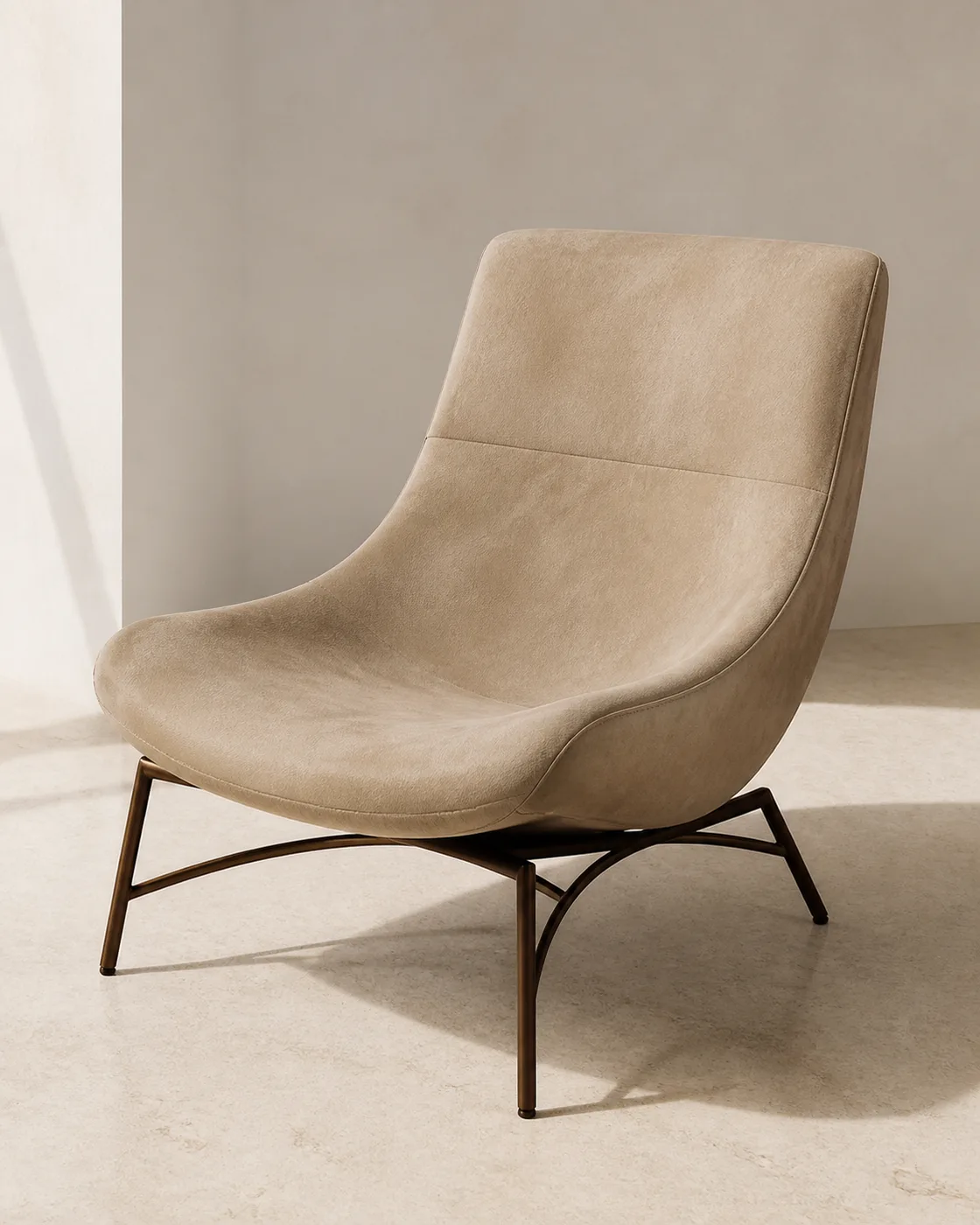
Sand Nubuck Leather on a dedicated furniture product.
This material-specific application image shows Sand Nubuck Leather on its own product and is not reused by any other material page. Final colour, pattern and finish remain subject to the approved physical sample.
Project notes
From sample to production.
01
What to specify
Choose by traffic, cleanability and desired patina. Aniline leather offers the richest character but less stain protection; protected or engineered leather is often preferred for high-turnover hospitality seating.
02
Fabrication & detailing
Allow for hide yield, natural defects, stretch direction and colour sorting. Reinforce perforations and high-stress seams; avoid sharp folds that can polish or crack prematurely.
03
Colour & finish approval
Natural hides vary in grain and marking. A control sample defines acceptable colour and character; cutting plans should place high-visibility panels consistently.
04
Care & maintenance
Dust with a soft cloth and use a pH-neutral leather cleaner approved for the finish. Avoid soaking, solvents, direct heat and prolonged strong sunlight.
Specification note
This page is a preliminary specification guide. No value, brand reference or material name constitutes automatic compliance. Current product data, test reports, physical sample or slab and the furniture construction must be approved for each project before ordering or manufacture.
Related materials