Hotel Linen Supplier in the UAE: How to Specify and Buy
Thread counts, towel GSM, par levels, and laundering standards for UAE hotel linen — and how supply works from a Dubai-based FF&E supplier.
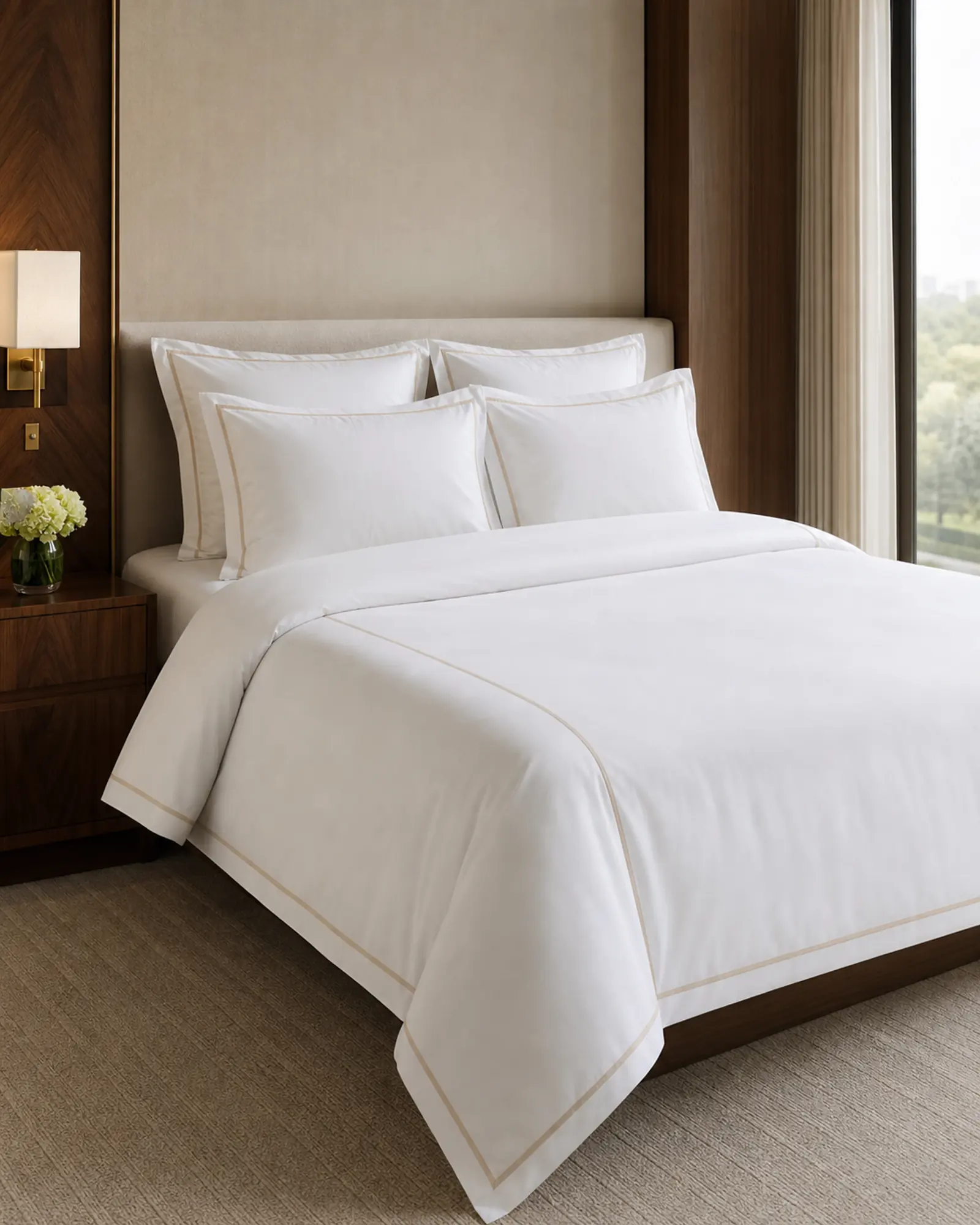
For an opening or refurbishment order, browse BSA’s hotel linen and textile supply and download the hotel linen brief. It records mattress and pillow sizes, towel requirements, laundry conditions and the room mix needed to prepare comparable quotations.
If you are opening or refurbishing a hotel in the UAE, the linen order is one of the largest textile purchases of the project and one of the easiest to get wrong. This guide covers what a hospitality linen package actually contains, the specifications that matter (thread count, GSM, fibre blends, laundering standards), the quantities hotels really buy, and how supply works when you order through a Dubai-based FF&E supplier like BSA Trading.
The mistake we see most often is specifying hotel linen the way you would buy bedding for a home: choosing by feel and thread count alone. Hotel linen lives a different life. A sheet in a busy property goes through industrial washing at 65–85°C as often as every second day, roughly 150 to 250 wash cycles per year. Retail-grade linen fails within months under that regime. Everything below follows from that one fact.
Professional rule: hotel linen is specified for its 200th wash, not its first night. If a sample impresses in the showroom but the fibre, weave, and hem construction cannot survive commercial laundering, it is the wrong product at any price.
What a complete hotel linen package contains
A full package is built per room category and per outlet, then multiplied by par level — the number of complete sets held per room so housekeeping can operate while linen is in the wash.
| Category | Items | Typical par level |
|---|---|---|
| Bed linen | Flat and fitted sheets, duvet covers, pillowcases, pillow and mattress protectors | 3–5 per room |
| Bath linen | Bath towels, hand towels, face cloths, bath mats, bathrobes | 3–5 per room |
| Pool and beach | Pool towels, lounger covers | 3 per lounger |
| F&B linen | Tablecloths, napkins, runners, buffet skirting | 3–5 per cover |
| Banquet | Banquet cloths, chair covers, skirting | Per event capacity |
| Spa | Massage sheets, towelling, waffle robes, slippers | 4–6 per treatment room |
Par level is where budgets go wrong. A 120-room hotel at par 4 buys 480 king duvet covers, not 120. When you compare supplier quotations, confirm every line is quoted at the same par level — a quotation that looks 30% cheaper is sometimes simply quoting par 3 against a competitor’s par 4.
Bed linen: the specifications that matter
Weave. Percale (plain weave, crisp, matte) is the default hospitality choice because it launders well and stays cool — relevant in the Gulf, where guests sleep under air conditioning but read “cool and crisp” as clean. Sateen (lustrous, heavier drape) reads more luxurious on the bed but shows wear and snagging sooner under commercial washing. Many 5-star properties compromise: percale sheets, sateen-finish duvet covers.
Thread count. T-250 to T-300 is the working standard for 4- and 5-star bed linen in this market. T-200 is acceptable for 3-star and staff accommodation. Counts above 400 add laundering cost and replacement frequency faster than they add guest-perceived quality.
Fibre. 100% long-staple cotton for 5-star guest-facing linen; 80/20 or 50/50 cotton-polyester for properties that prioritise laundry economics, since the blend dries faster, needs less pressing, and holds dimension. The honest trade-off: blends pill sooner and never quite match the hand-feel of cotton. We recommend deciding this per room category — cotton in suites, blend in standard rooms is a common and defensible split.
Construction details that outlast the fabric choice. Double-stitched or French-seamed hems, reinforced corners on fitted sheets, hidden zip or bag-style duvet closures rather than buttons (buttons are the first casualty of a tunnel washer), and side-tab orientation labels so housekeeping stops stretching king sheets onto queen beds.
Sizes. UAE hotels run larger beds than European standards — king at 180×200 cm or 200×200 cm is common, and superior categories increasingly use 200×210 cm mattresses with deep 30–35 cm profiles. Measure the actual mattress with its topper before confirming the cutting sheet; the single most common linen complaint after opening is fitted sheets that will not stay on a deep mattress.
Bath linen: GSM is only half the specification
Towel weight (GSM, grams per square metre) is the headline figure — 500–550 GSM standard, 550–650 GSM for 5-star and spa. But two other parameters decide how the towel performs in month six:
- Yarn type. Ring-spun cotton gives the soft, dense pile guests notice. Combed cotton removes short fibres and lints less. Twist level matters: low-twist feels plush but wears faster; standard twist lasts longer.
- Ground weave and selvedge. The woven ground under the pile, plus a properly woven (not merely hemmed) selvedge, is what stops a towel distorting after repeated high-temperature washing.
Bathrobes follow the same logic: 400–450 GSM terry or waffle-weave around 300 GSM for pool and spa areas, where drying speed beats plushness.
F&B and banquet linen
Restaurant and banquet linen takes more abuse than anything in the guest room — food staining, bleach-adjacent wash chemistry, and constant handling. The standard answer is 100% spun polyester damask or plain weave: it holds colour through hundreds of washes, resists staining, and needs minimal pressing. Cotton-feel spun polyester has largely replaced cotton tablecloths in Gulf hospitality, and we specify it for banquet programs without hesitation. Where a fine-dining concept insists on cotton or linen-blend cloths, budget for a significantly higher replacement rate and say so in the operating budget, not just the FF&E budget.
Napkins are bought at 3 to 5 times cover count. Banquet cloths are cut to the actual table inventory — confirm drop length (typically to within 2–3 cm of the floor for formal setups) against the real tables, not the catalogue dimension.
Laundering standards: the specification behind the specification
Confirm that the selected linen is suitable for the hotel’s actual industrial laundering processes. Ask suppliers for applicable test reports and certifications:
- ISO 15797:2017 — industrial washing and finishing test procedures for workwear. The standard does not automatically qualify hotel linen for tunnel washers or high-temperature finishing. Agree suitable test methods for the selected linen and verify compatibility with the laundry’s actual equipment and processes.
- OEKO-TEX STANDARD 100 — certifies that the covered textile article has passed the applicable harmful-substance tests and limit values for its product class. Check the certificate’s validity, product scope and the operator’s requirements.
- Colour fastness to washing and chlorine (ISO 105 series) — critical for pool towels and any coloured F&B linen.
If a quotation cannot state these, you are looking at retail product in a commercial quantity. It will be cheaper. It will also be re-ordered within the year, and the second order never gets cheaper.
How supply works through BSA
BSA Trading supplies hotel linen from Dubai as part of complete FF&E packages or as a standalone textile order. Production runs through contract textile mills in Turkey — the same sourcing base as our soft furnishings program — with embroidered or woven-label branding to the property’s identity.
The process, in practice:
- Room-count and par-level schedule. We build the quantity matrix from your room mix, outlet covers, and chosen par levels — this becomes the single document both sides quote and deliver against.
- Specification and sampling. Weave, thread count, GSM, fibre, and sizes confirmed against physical samples, washed and re-presented if the project timeline allows. We put sample pieces through a commercial wash cycle before sign-off when the operator requires it.
- Production and branding. Typical production lead time is 6 to 10 weeks depending on quantities and embroidery complexity, plus sea freight to Jebel Ali. Air freight is possible for opening-critical partial shipments; it is worth planning so that it is never needed.
- Delivery to schedule. Linen arrives bulk-packed by room category and par set, which is a small detail that saves the housekeeping team days at opening.
Minimums are project-scaled rather than catalogue-fixed: a boutique property of 40 rooms is a workable order; single-carton retail quantities are not what this program is for.
Linen rarely travels alone. Most projects order it alongside curtains, cushions, and bed runners, upholstery and curtain fabric, and the wider furniture package — one consolidated FF&E order with one delivery schedule, which is the point of buying through an FF&E supplier rather than assembling five vendors. For how the whole package fits together commercially, see our hotel FF&E procurement guide.
Getting a linen quotation
Send us the room mix, operator brand standard (if flagged), and target opening date, and we will return a par-level quantity schedule with specifications and pricing. If you only have the room count so far, that is enough to start. Request a quotation or browse the textile collection first.