Bespoke Lighting for UAE Hotels, Palaces, and Villas
How custom chandeliers and decorative lighting are engineered for UAE projects: finishes for coastal air, ceiling loads, ECAS compliance, and lead times.
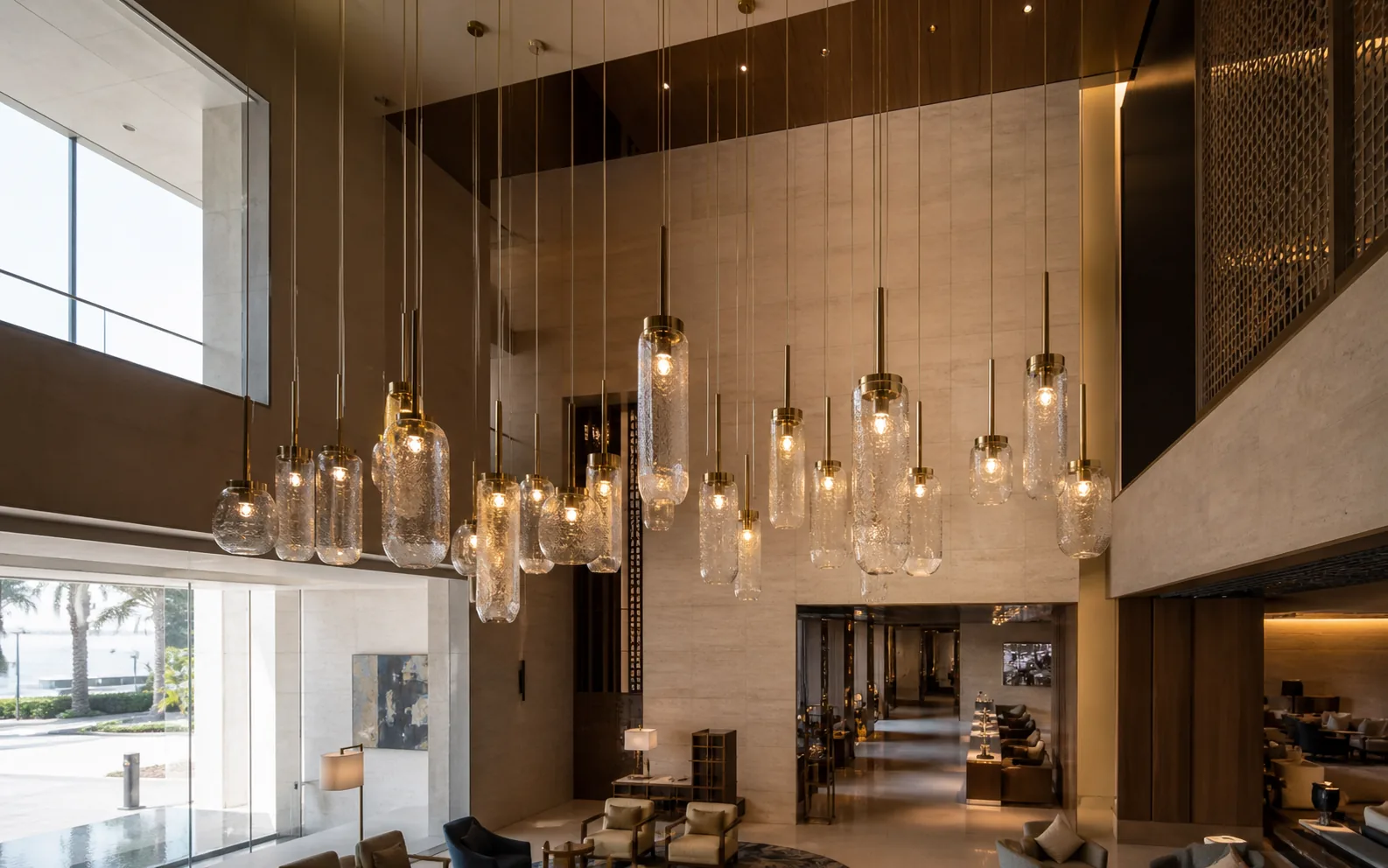
Bespoke lighting means a fixture made to a project’s dimensions, finish and lighting brief. It can be a single statement chandelier or a repeated family of wall lights, pendants and lamps. The quotation should distinguish design development, sampling, manufacturing, delivery and installation responsibilities.
For a UAE project, start with BSA’s hotel and restaurant lighting supply, or download the editable lighting brief. Send the fixture quantities, room section and finish references to request a lighting quotation.
What to include in a bespoke lighting specification
| Decision | Information to confirm |
|---|---|
| Size and position | Overall dimensions, ceiling height, suspension length and relationship to furniture |
| Appearance | Metal substrate, approved finish sample, glass or shade material and reference images |
| Light and controls | Light source, colour temperature, dimming protocol and replaceable components, agreed with the lighting designer |
| Installation | Fixture weight, fixing responsibility, site assembly and maintenance access |
| Commercial scope | Quantity by fixture code, samples, project documents, packing, freight and delivery date |
Bespoke lighting is where a hospitality or villa interior either becomes specific to its project or stays a catalogue assembly. A lobby chandelier scaled to its actual atrium, majlis wall lights that match the joinery, brass floor lamps built for a villa’s proportions — these are manufactured objects, engineered from drawings, and buying them well requires knowing how they are made. This guide covers the design-to-installation process, materials and finishes that survive the Gulf, the engineering and compliance points that stall projects, and the lead times to plan around.
Where bespoke lighting earns its cost
Custom manufacturing costs more than catalogue selection, so it should be spent where it is visible and structural to the design: the arrival statement (lobby, atrium, stair void), the primary majlis or reception room, F&B venues where lighting defines the concept, and villa living spaces where ceiling heights or room proportions make stock fixtures look wrong. Corridors, back of house, and guestroom functional lighting almost never justify bespoke work — spend there on good catalogue product and put the difference into the statement pieces.
The scale argument is practical, not aesthetic. Stock chandeliers top out around 120–150 cm diameter; a double-height lobby or a 6-metre villa majlis ceiling swallows that size. Bespoke manufacturing is often the only way to get a correctly proportioned fixture at 2, 3, or 5 metres.
Materials and finishes for the Gulf
Brass and metals. Solid brass, brass-plated steel, stainless, and blackened bronze cover most decorative programs. The specification point that matters in the UAE: finish protection. Unlacquered brass patinates fast in humid, saline coastal air — a designed effect on one heritage piece, a maintenance complaint across a matched set. For coastal and pool-adjacent positions we specify lacquered, powder-protected, or PVD finishes and say so on the drawings, because “brass, antique finish” alone leaves the decision to the factory.
Glass. Hand-blown elements, pressed and moulded glass, fluted and reeded profiles, and alabaster or onyx diffusers each carry different unit costs and different breakage-replacement logic. Whatever is chosen, order spare elements in the same production batch — hand-blown glass especially varies batch to batch, and a single broken globe on a 60-globe chandelier should be a stores item, not a re-commission.
Fabric and specialty shades. Fabric shades in public areas must use fire-rated materials like every other textile in a licensed venue — the same composite logic covered in our contract fabrics guide.
Engineering: the part renders skip
Every statement fixture is a structural object hanging above people. Before production, three engineering questions need documented answers:
- Weight and fixing. Large chandeliers run from 40 kg to several hundred; the ceiling needs a rated fixing point or spreader structure, coordinated with the slab or steel — not with the false ceiling, which holds nothing. This is a design-stage coordination item with the main contractor.
- Suspension and levelling. Multi-tier pieces need adjustable suspensions for levelling after installation, and atrium pieces need a defined method statement for how they are raised and fixed.
- Maintenance access. Decide at design stage how lamps get changed and dust gets cleaned at 9 metres: winch systems that lower the fixture, davit access, or scheduled scaffold/MEWP access. Retrofitting a winch after the ceiling closes is expensive; forgetting it means the chandelier is cleaned once a year at best.
Electrical compliance. Do not write “ECAS compliant” as a blanket note and assume the issue is closed. Before quotation, classify each fixture and light source against the current Ministry of Industry and Advanced Technology regulated-product scope. Products within scope require the applicable conformity route and supporting test report from an accredited laboratory; depending on the product, the file may cover luminaire safety, hazardous-substance limits, and energy-efficiency information. The exact obligations differ between a complete luminaire, a replaceable lamp, an integrated LED source, and control gear, so an approved driver does not by itself certify the assembled custom fixture. Use IEC/EN 60598-1 as the luminaire safety baseline where applicable, then request the bill of materials, test reports, labels, and Arabic/English product documentation needed for the project’s approval file. Hotel projects additionally inherit the operator’s electrical standards. Fix supply voltage, driver access, dimming protocol (DALI per IEC 62386, 0–10V, or phase-cut), bathroom and exterior IP ratings, and local authority acceptance before production. Compliance documentation is part of the supply scope and should be requested with the quotation, not after delivery.
The process, from brief to installed fixture
- Design development (2–4 weeks). From the designer’s concept or reference images to dimensioned proposals: form, scale checked against the actual room section, materials, light sources, and budget range.
- Sampling. Finish plates for every metal treatment and a sample glass or diffuser element. On large programs, one full prototype fixture of a repeated design — the lighting equivalent of the FF&E mock-up room, and it catches the same class of errors.
- Shop drawings and engineering. Fixing details, weights, suspension, driver positions, and control compatibility, coordinated with the MEP and fit-out drawings.
- Production (10–16 weeks for statement pieces). With photographed progress reports and pre-shipment testing — every fixture powered on and dimmed before packing.
- Delivery and installation. Statement pieces ship in engineered crates with site assembly sequences; installation is coordinated with ceiling closure and lighting control commissioning. The scheduling logic sits inside the wider FF&E procurement checklist.
Lead time planning is the discipline: a lobby chandelier ordered five months before opening is on the critical path; ordered eight months before, it is routine. Lighting belongs in the first FF&E purchase orders — see FF&E lead times by sourcing country.
Matching lighting to the wider FF&E package
Bespoke lighting rarely travels alone. Metal finishes should match or deliberately complement ironmongery and furniture detailing; shade fabrics should come from the same palette as the soft furnishings program; and majlis and reception lighting should be developed with the seating layout, not after it — a chandelier centred on a room is wrong if the majlis seating plan is not symmetrical about the same axis. This is the argument for buying lighting inside the furniture package: one supplier carries the finish schedule across every object in the room.
BSA Trading manufactures bespoke lighting programs alongside furniture for hotels, palaces, and villas across the UAE and GCC. Browse the lighting collection for the stock and semi-custom starting points, or send us the drawings — a room section and a reference image are enough to open a design development round.